Anger Reset – Anger Management Sound & Calm Tool | Medihertz
Medihertz Anger Reset β€” Pause. Breathe. Reset.
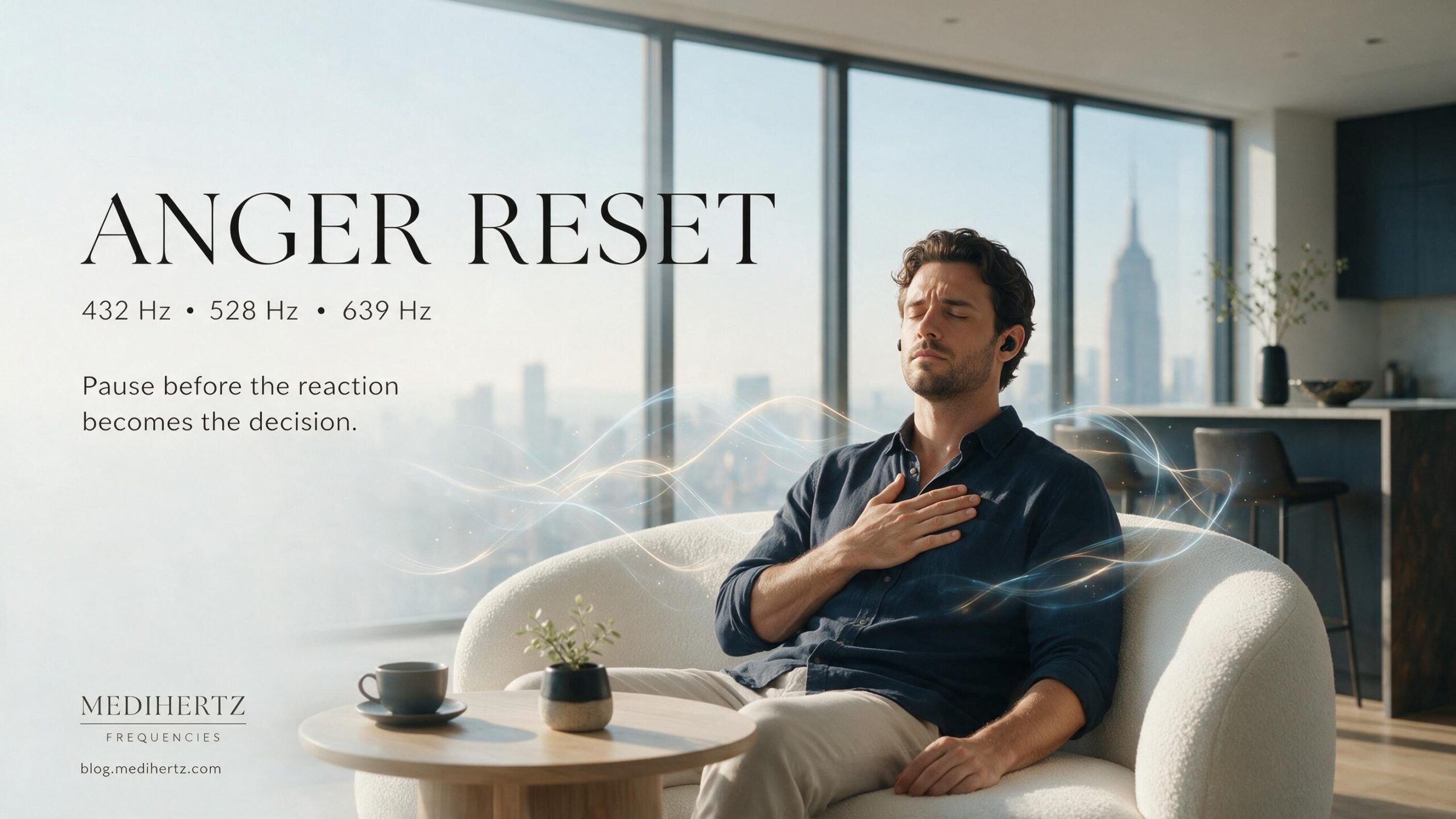
MEDIHERTZ Anger Reset

Medihertz

Anger Reset

Pause. Breathe. Reset.

A private space to slow down, listen, breathe and choose your next response β€” trigger, pause, calm, reflect, respond.

Headphones recommended for the full sound experience.

How are you feeling right now?

What do you need right now?

The fastest way in

30-Second Power Relax

You don't have to react yet. Thirty seconds of slow breath and low sound is enough to open a door.

One tap Β· nothing to configure

Reset sessions

Choose a reset session

Tap a session and it starts playing right away β€” right here, on this page. Switch sessions, volume and timer any time. The full visualizer stays optional, one tap from the player.

Sound room

Calming sound environments

Tap a sound to preview it. These are textures generated live in your browser β€” not field recordings. Paste your own audio URLs into MAR_AUDIO_LIBRARY to swap in real recordings.

Frequency room

Tones & vibrations

Explore tones and vibrations as part of your personal relaxation practice. These are sound experiences β€” not treatment, and not medical claims.

432 Hz

Your sound

Build a simple mix

One frequency, one background, two sliders. That's the whole synth β€” no knobs, no math.

Hz

432 Hz Β· Gentle Rain Β· 5 min

Breathe

Follow the light

Just a few words and a moving light β€” in, hold, out. Begin whenever, leave whenever. No setup.

Endless session Β· exits with one tap

Small guidance

When this happens…

Short notes for the moments anger shows up wearing a disguise.

Spiritual reflection Β· optional

A different way to see anger

Sometimes anger grows because we become deeply attached to our expectations, our achievements, our identity, and our idea of how life should unfold. The event stings; the attachment burns.

"What if this moment is not an attack on 'me'?"
"What if this difficult moment is simply one chapter in a much larger journey?"

We are temporary participants in a much larger universe β€” and we are allowed to let moments move through us instead of pinning them down. This is one way of seeing, offered for reflection. It is not a scientific claim and not a replacement for care or professional support.

Ego & expectation reflection

What is really hurting?

Pick one question. Sit with it for a breath or two. There is no wrong answer and nothing is being scored.

Sometimes the event is smaller than the story we attach to it.

Response training

Reaction β†’ Response

The pause between trigger and reaction is where your freedom lives. Walk through a few examples.

Your daily calm

Calm becomes easier to reach when you practice it before you need it.

Ten quiet minutes β€” sound, breath, one short reflection. A small daily practice of emotional self-regulation.

Guidance

Questions, answered quietly

Is the Medihertz Anger Reset tool free?

Yes. Every session, sound, breathing guide and reflection in this tool is free to use, directly in your browser. No account, no sign-up, no personal data required.

How does an anger reset actually work?

It follows one simple path: trigger β†’ pause β†’ calm β†’ reflect β†’ respond. A short pause lowers the first wave of activation, slow breathing settles your body, calm sound gives your attention somewhere soft to rest, and one or two gentle questions help you choose a response you'll respect tomorrow.

Do I need headphones?

Headphones give you the full depth of the sound and tone layers, but the experience works fine through speakers. Keep your volume at a comfortable level and stop if listening ever causes discomfort.

Do specific frequencies treat anything?

No β€” and nothing in this tool should be understood that way. The Frequency Room is an exploratory relaxation environment. You're welcome to use tones as part of a personal mindfulness practice, but they are not medical treatment and we make no clinical claims about them.

Is this therapy or medical advice?

No. Medihertz Anger Reset is a wellness and self-regulation experience β€” breathing, sound and reflection. It does not diagnose or treat mental-health conditions, and it is not a replacement for professional care. If you feel you're in danger of harming yourself or someone else, please seek immediate help from a professional, a trusted person, or your local emergency service.

A note on safety

Medihertz Anger Reset is a wellness and self-regulation experience. It does not diagnose or treat mental-health conditions and is not a replacement for professional care.

Do not use while driving or operating machinery. Keep your listening volume comfortable, and stop if listening causes discomfort.

If you may be in immediate danger of harming yourself or someone else, please step away from this tool and reach out for immediate professional or emergency help.
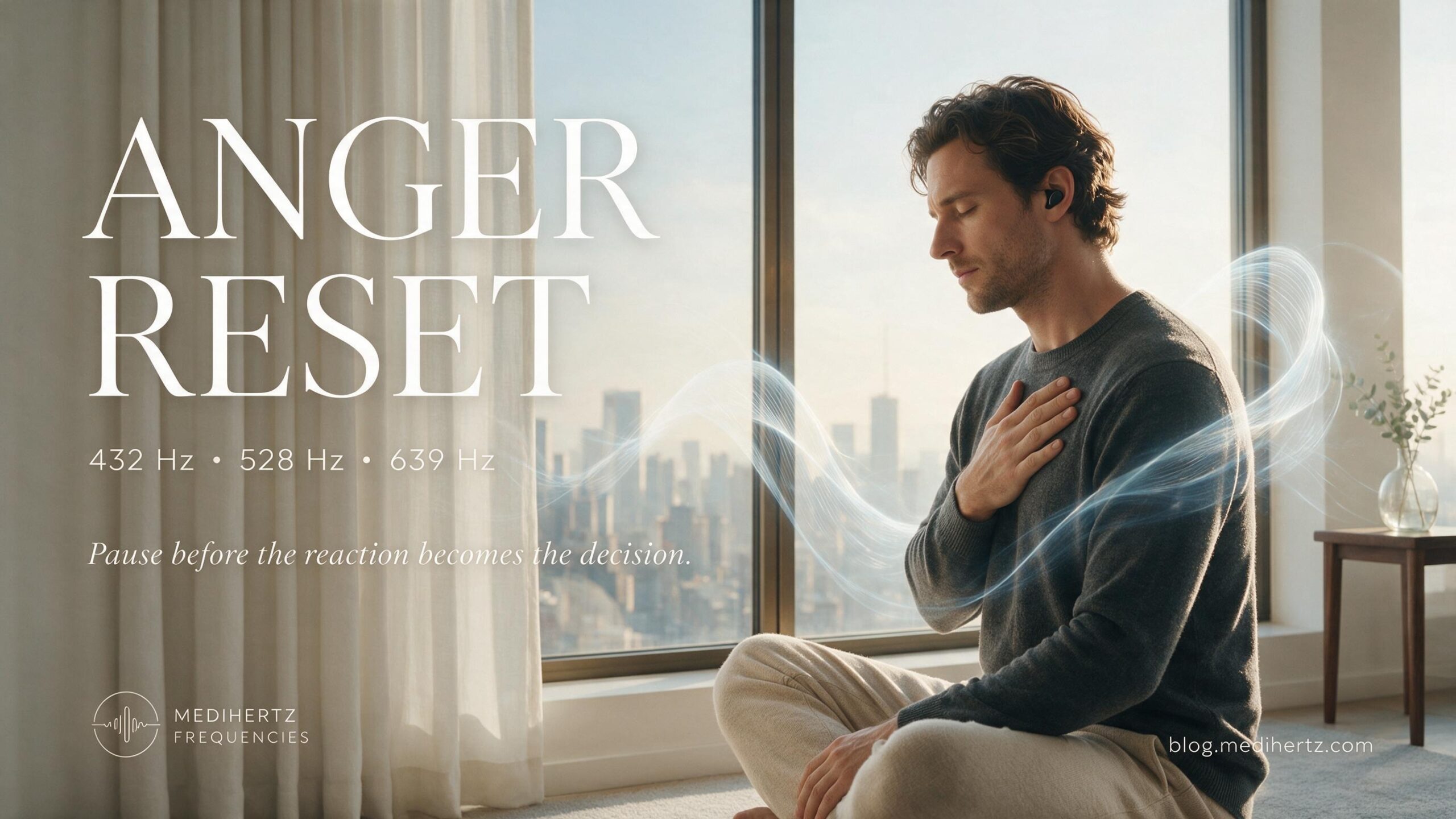
Medihertz Β· Anger Reset Pause. Breathe. Reset. Built to be felt slowly.

Medihertz Anger Reset sound frequency tool for anger management, calm and emotional self-regulation

Medihertz Anger Reset: A Practical Guide to Anger Management, Emotional Control & Inner Calm

Anger is human. You will get frustrated. People will disappoint you. Plans will fail. Someone will say something that hurts you. Sometimes life will place you in situations you never wanted.

The important question is not:

“How do I never become angry?”

It is:

“What do I do with my anger once it appears?”

Medihertz Anger Reset is designed around that question.

It combines sound-based calming sessions, breathing, mindfulness, reflection and a spiritual philosophy of detachment to help you practice creating a pause between an emotional trigger and your response.

https://images.openai.com/static-rsc-4/lkepwdA-c29Ty005NWMW87Z-I4f1Cb4cGUVcvUMaKGW27hpGgZbX7UJ7dz10qVtSkypaDhH8TJsrwKORdKWfrWrJSt_gTO93-warapnHDM81icZNpcXiek9AMzvB4YdAhdNXrQGk2tRwH6gOI3EtZqg0Ywxmha_Bh3hqVaQ5BMqlImZowk9bspZIP86O0e1h?purpose=fullsize
6

What Is Medihertz Anger Reset?

Medihertz Anger Reset is a free, sound-based anger management and emotional self-regulation tool designed for moments of anger, irritation, frustration, overwhelm and racing thoughts.

Instead of waiting for a scheduled session, you can open the tool when you need a pause and choose a sound experience that matches your situation.

You can use it:

  • At home
  • In your office
  • During a work break
  • On a train or bus
  • After an argument
  • Before responding to a difficult message
  • Before an important conversation
  • During your daily mindfulness practice
  • Whenever you feel yourself becoming reactive

The goal isn’t to suppress anger.

The goal is to create enough space to choose your response.

Research on anger regulation supports the value of approaches such as relaxation, mindfulness and cognitive reappraisal, while the American Psychological Association recommends strategies including recognizing warning signs, relaxation, changing unhelpful thought patterns and improving communication.


Medihertz Anger Reset sound frequency session helping users pause, breathe and respond calmly to anger

The 30-Second Rule: Don’t React Yet

When anger suddenly rises, your first instinct may be to do something.

Reply.

Argue.

Call.

Shout.

Send the message.

Prove your point.

Walk toward the person.

Try something different.

Don’t react yet.

Give yourself 30 seconds.

Put on your earphones.

Start a short Anger Reset session.

Take slow breaths.

Let the first wave of emotion pass before deciding what to do.

This is not weakness.

It is practice.

The American Psychological Association specifically recommends noticing the warning signs of anger and stepping away or using relaxation techniques before irritation escalates.

Remember:

The first reaction is an emotion.

The second response can be a choice.


Anger Reset anger management sound frequencies for calming emotions and creating a pause before reacting

Why Do We Get So Angry?

One useful way to understand anger is through expectation.

We expect respect.

We expect appreciation.

We expect fairness.

We expect success.

We expect people to behave according to our standards.

We expect life to follow our plans.

And when reality doesn’t match those expectations, something inside us protests:

“This shouldn’t be happening.”

“How could they do this to me?”

“I deserve better.”

“Why me?”

The problem isn’t that every expectation is wrong.

The problem begins when an expectation becomes so connected to our identity that anything violating it feels like an attack on “me.”

The APA similarly notes that angry thinking can involve demanding expectations about fairness, appreciation or agreement, and recommends turning rigid demands into more flexible requests.


Medihertz Anger Reset sound frequency wellness tool for calm, mindfulness and emotional self-regulation

The Ego, Expectations & Anger

This is where the spiritual philosophy of Medihertz Anger Reset begins.

You can think of the ego as the part of our identity that constantly says:

My success.

My respect.

My reputation.

My achievement.

My opinion.

My way.

My expectations.

The stronger our attachment to these things becomes, the more personally we may experience events that challenge them.

Someone interrupts you.

The ego says:

“How dare they?”

Someone criticizes your work.

The ego says:

“They don’t respect me.”

Someone doesn’t give you what you expected.

The ego says:

“I deserve better.”

Someone puts you in an uncomfortable situation.

The ego says:

“Why is this happening to me?”

And suddenly the original event becomes much larger than the event itself.


Anger Reset anger management sound frequencies for calming emotions and creating a pause before reacting

A Spiritual Experiment: What If This Moment Is Not About “Me”?

Medihertz Anger Reset offers a philosophical question:

What if every difficult moment doesn’t have to become a battle for your ego?

You don’t have to believe that the universe literally controls every event.

Instead, treat this as a spiritual perspective for reflection.

Imagine that your life is one small part of something much larger.

The universe contains galaxies, planets, ecosystems, animals, plants, humans and countless processes operating beyond your individual control.

You are participating in this enormous system.

You cannot control everything that happens.

But you can practice deciding how you participate in what happens.

That perspective can create detachment.


Anger Reset anger management sound frequencies for calming emotions and creating a pause before reacting

“I Am Visiting This Body”

Another spiritual reflection is:

“I am temporarily experiencing this life through this body.”

Before this particular body existed, you were not experiencing the world in this form.

One day, this body will no longer exist.

Between those two points is your current chapter.

From a spiritual perspective, you can therefore ask:

If this life is a temporary chapter, do I really want to spend every difficult moment fighting to protect my ego?

Someone insulted you.

Someone disappointed you.

Someone didn’t recognize your achievement.

Something didn’t happen according to your plan.

Perhaps the question doesn’t have to be:

“How can I win this?”

It can become:

“What can I learn from this chapter?”

That is a philosophical practiceβ€”not a claim that every painful event has a predetermined cosmic explanation.


Medihertz Anger Reset sound frequency wellness tool for calm, mindfulness and emotional self-regulation

The “Universe Has Another Chapter” Practice

When something goes wrong, try this thought:

“This situation has happened. I don’t yet know what it will lead to. I can learn from it without allowing it to destroy my inner peace.”

Instead of:

“Why is this happening to me?”

Try:

“What can I understand from this?”

Instead of:

“This person ruined everything.”

Try:

“What is within my control now?”

Instead of:

“My life is going wrong.”

Try:

“This is one difficult chapter, not necessarily the entire story.”

This is where spiritual reflection meets practical emotional regulation.


Anger Reset anger management sound frequencies for calming emotions and creating a pause before reacting

What NOT To Do When You’re Angry

This is one of the most important sections of your Anger Reset philosophy.

1. Don’t send the message immediately

❌ Don’t:

Write the angry message and press send.

βœ… Instead:

Write it if you need toβ€”but don’t send it yet.

Take your Anger Reset session.

Breathe.

Read the message again later.

Ask:

“Will I still want to send this when I’m calm?”


2. Don’t try to win the argument

❌ Don’t:

Keep arguing simply because you need the other person to admit you’re right.

βœ… Instead:

Ask:

“Do I want to win this conversation, or do I want to improve the situation?”

Being right and responding wisely are not always the same thing.


3. Don’t use “always” and “never”

❌ Don’t:

“You always do this.”

“You never listen.”

“Nothing ever works.”

These statements turn one event into a permanent story.

βœ… Instead:

Describe the actual event.

“That happened today, and it upset me.”

The APA specifically recommends avoiding extreme words such as “always” and “never” because they can intensify angry thinking and damage communication.


4. Don’t replay the argument for hours

❌ Don’t:

Keep replaying the conversation in your head:

“I should have said this…”

“Why didn’t I say that?”

“Next time I’ll destroy him…”

This is anger rumination.

βœ… Instead:

Notice the replay.

Say:

“The event is over. My mind is replaying it.”

Then bring your attention back to breathing, sound or something constructive.

Research examining emotion-regulation strategies has found consistent associations between anger and rumination, while acceptance and reappraisal show more favorable relationships with anger regulation.


5. Don’t use anger as proof of strength

❌ Don’t think:

“If I don’t react, they’ll think I’m weak.”

βœ… Remember:

Calm does not mean powerless.

You can have boundaries without aggression.

You can disagree without shouting.

You can leave a conversation without losing.

You can say no without becoming hostile.

Assertive communication is different from aggressive communication; the APA recommends expressing needs clearly and respectfully rather than hurting or humiliating others.


6. Don’t make major decisions at peak anger

❌ Don’t:

Quit your job.

End a relationship.

Send an accusation.

Make a public post.

Threaten someone.

Make an irreversible decision.

βœ… Instead:

Pause β†’ Calm β†’ Think β†’ Decide.

A decision made tomorrow may look very different from a decision made during an emotional peak.


Medihertz Anger Reset sound frequency tool for anger management, calm and emotional self-regulation

7. Don’t “vent” just to make yourself angrier

It can feel satisfying to repeatedly talk about how terrible someone is.

But repeatedly rehearsing the anger may keep the emotional cycle alive.

A 2024 meta-analysis found that activities aimed at reducing physiological arousalβ€”such as breathing, mindfulness and meditationβ€”were more effective for reducing anger and aggression than arousal-increasing activities, and did not support the idea that simply venting anger is an effective anger-management strategy.

Instead:

Turn down the heat first.

Then solve the problem.


Medihertz Anger Reset sound frequency session helping users pause, breathe and respond calmly to anger

What To Do When Someone Yells At You

Imagine someone suddenly raises their voice.

Your old response might be:

“Don’t you dare talk to me like that!”

Then they become louder.

You become louder.

The situation escalates.

Try the Anger Reset response:

1. Stop.

2. Breathe.

3. Listen to what is actually being said.

4. Separate the person’s behavior from your identity.

5. Decide whether the conversation needs to continue.

You might say:

“I want to discuss this, but I don’t want us to shout at each other. Let’s talk when we’re calmer.”

That’s not surrender.

That’s emotional control.


Medihertz Anger Reset sound frequency tool for anger management, calm and emotional self-regulation

What To Do When Someone Disrespects You

❌ Don’t:

Immediately insult them back.

βœ… Instead:

Ask yourself:

“Do I need to defend my boundary, or defend my ego?”

Those are different things.

If a boundary has genuinely been crossed, communicate it clearly.

“I don’t accept being spoken to that way.”

Then, if necessary, leave the conversation.

Calmness does not require accepting disrespect.


What To Do When Someone Cuts You Off in Traffic

❌ Don’t:

Chase them.

Honk continuously.

Shout.

Try to teach them a lesson.

βœ… Instead:

Recognize:

“I’m angry because I expected other drivers to behave differently.”

Take a breath.

Create distance.

Continue your journey.

You don’t need to turn someone else’s bad driving into an hour of bad emotion.


What To Do When Someone Criticizes You

❌ Don’t immediately think:

“They don’t respect me.”

βœ… Ask:

“Is there something useful here?”

If there is, learn from it.

If there isn’t, let it pass.

Criticism doesn’t automatically define you.


What To Do When Plans Suddenly Fail

Your flight is delayed.

Someone cancels.

A project fails.

An opportunity disappears.

❌ Don’t:

Immediately decide:

“Everything is ruined.”

βœ… Instead:

Ask three questions:

What happened?

What can I control?

What is my next useful action?

You don’t need to like what happened.

You only need to decide what happens next.


What To Do When Your Mind Says “I Deserve Better”

Pause.

Maybe you do deserve better.

But ask:

“What can I actually do about it?”

If you can change the situation:

Act calmly.

If you can communicate:

Communicate clearly.

If you can leave:

Leave respectfully.

If you cannot control it:

Practice letting go.

This is the difference between healthy action and emotional reaction.


The Three Questions That Can Interrupt Anger

Whenever you’re triggered, ask:

1. What happened?

Only the facts.

2. What story am I telling myself about what happened?

This is where expectations, assumptions and ego often enter.

3. What response will I respect tomorrow?

That third question is powerful.

Because your goal isn’t to feel victorious for 30 seconds.

Your goal is to become someone who can look back at difficult situations and say:

“I handled that better than I used to.”


Your Daily Anger Management Practice

Don’t wait until you’re furious to practice emotional control.

The skill is easier to access when you’ve practiced it beforehand.

Every day:

5–10 minutes

Put on your earphones.

Choose Daily Calm.

Sit comfortably.

Breathe naturally.

Listen.

Notice thoughts without chasing them.

Then ask:

“What am I expecting from today?”

“What can I control?”

“What can I release?”

“How do I want to respond when something goes wrong?”

This turns Anger Reset from an emergency button into an everyday emotional self-regulation practice.

Research on mindfulness and anger is encouraging: a 2025 meta-analysis covering 118 correlational and experimental studies found associations between mindfulness and lower anger and aggression, while experimental mindfulness interventions showed reductions relative to controls.


The Goal Isn’t to Become Emotionless

This is important.

Calm does not mean emotionless.

You can be angry and remain calm.

You can be disappointed and remain calm.

You can disagree and remain calm.

You can protect yourself and remain calm.

You can walk away and remain calm.

You can say no and remain calm.

The objective is not to remove your emotions.

The objective is to stop your emotions from automatically deciding your behavior.


From Reactive to Responsive

Think of your emotional growth as a progression.

Stage 1 β€” React

Something happens.

You immediately respond.

Stage 2 β€” Notice

Something happens.

You recognize:

“I’m getting angry.”

Stage 3 β€” Pause

You notice the anger and create space.

Stage 4 β€” Observe

You ask:

“What am I expecting?”

“What am I protecting?”

“What is actually happening?”

Stage 5 β€” Choose

You decide what response makes sense.

Stage 6 β€” Detach

You stop allowing every external event to determine your internal state.

Stage 7 β€” Practice

You repeat the process until the pause becomes more natural.

That is the transformation.


Your Inner World Doesn’t Have to Copy the Outside World

The world around you will never be completely predictable.

People will behave differently.

Plans will change.

Problems will appear.

Some things will be unfair.

Some things will hurt.

The spiritual goal is not to create a world where nothing disturbs you.

It is to gradually create an inner space where everything doesn’t have to disturb you.

Someone can be angry.

You don’t have to become angry with them.

Someone can be impatient.

You don’t have to become impatient.

Someone can misunderstand you.

You don’t have to immediately attack them.

Something can go wrong.

You can still breathe.

You can still think.

You can still choose.


A Simple Mantra for Difficult Moments

When you feel anger rising, remember:

Pause.

Breathe.

Observe.

I don’t have to react immediately.

This moment will pass.

What can I control?

What can I learn?

What response will protect my peace and my values?

Then listen.

Let the sound give you a few minutes of space.


Your Anger Reset Journey

You don’t have to become calm in one day.

You don’t have to eliminate anger.

You don’t have to become a different person overnight.

Start with one moment.

Then another.

The person who once reacted in three seconds may eventually pause for ten.

Ten seconds may become thirty.

Thirty seconds may become a minute.

And eventually you may notice something surprising:

The situation that once controlled you doesn’t control you in quite the same way anymore.

That’s the practice.

That’s the reset.

That’s the journey from reaction to awareness, from awareness to choice, and from choice to inner calm.


Use Medihertz Anger Reset When You Need a Pause

Feeling angry?

Don’t make the next decision from the peak of the emotion.

Put on your earphones.

Choose a session.

Breathe.

Listen.

Reflect.

Then decide.

PAUSE. BREATHE. RESET.

Your circumstances may not always be in your control. Your next response can become your practice.


Important Safety Note

Medihertz Anger Reset is a wellness and self-regulation tool, not a substitute for professional mental-health care, psychotherapy, crisis support or medical treatment.

If anger feels uncontrollable, frequently leads to threats or violence, causes serious problems in your relationships or work, or makes you concerned that you may hurt yourself or someone else, seek help from a qualified mental-health professional or appropriate emergency support.

The tool should be used as a complement to healthy coping and professional support when neededβ€”not as a promise to cure an anger disorder.


Frequently Asked Questions About Anger Management

What is the best way to calm down when you’re angry?

A useful first step is to pause the interaction, reduce physiological arousal, breathe slowly, and give yourself time before responding. Relaxation, mindfulness and cognitive reappraisal are among the strategies supported in anger-management research.

How can I stop reacting immediately when I’m angry?

Practice recognizing your personal warning signs before anger reaches its peak. Then create a deliberate pause: step away when appropriate, breathe, listen and ask what response you will respect later.

Does mindfulness help with anger?

Research suggests it can. A 2025 meta-analysis found that mindfulness was associated with lower anger and aggression, and mindfulness-based interventions produced reductions in anger and aggression compared with controls.

Should I vent when I’m angry?

Simply increasing or repeatedly rehearsing anger is not necessarily helpful. Evidence from a large 2024 meta-analysis favored activities that reduce arousal, including breathing, mindfulness and meditation, over approaches designed to increase arousal.

How do I control anger during an argument?

Pause before responding, avoid insults and absolute statements such as “always” and “never,” listen to what the other person is saying, and communicate your needs assertively rather than aggressively. If necessary, take a break and return to the conversation later.

Can a sound-based practice replace anger-management therapy?

No. A sound-based wellness tool can provide a convenient opportunity to practice relaxation, mindfulness and self-regulation, but it should not be presented as a replacement for professional anger-management treatment when professional help is needed.

How often should I practice anger management?

Regular practice can make calming techniques easier to access when difficult situations occur. A short daily practice can be used to build familiarity with breathing, mindfulness, observation and cognitive reframing.


Medihertz Anger Reset sound frequency tool for anger management, calm and emotional self-regulation

The Medihertz Anger Reset Philosophy

You cannot control every person.

You cannot control every event.

You cannot control every outcome.

But you can practice controlling the distance between what happens and what you do next.

Perhaps that is where real calm begins.

Not when the world becomes peaceful.

When your inner world learns how to remain peaceful while the world is not.

☸