
Find My Tinnitus Frequency™
Match your tinnitus tone and discover personalized sound relief — engineered for clarity, comfort and calm.
This tool provides an estimation and is not a medical diagnosis. Consult a qualified healthcare professional for medical advice.
0.04
Find Your Tinnitus Frequency Onlin
Find Your Tinnitus Frequency Online
Tinnitus often sounds like ringing, buzzing, hissing, or whistling — but the pitch is different for everyone.
This tool helps you match the frequency of the sound you hear by playing a clean tone and allowing you to fine-tune it until it feels close to your internal sound.
Once you find your approximate frequency, you can better understand what you’re experiencing and explore sound-based coping options.

Find Your Tinnitus Frequency Quickly
👉What Frequency Cancels Out Tinnitus? (Simple Guide + Free Tools)
Read
👉 What Frequency Cancels Out Tinnitus? (Simple Guide + Free Tools)
👉 Advanced Hearing Test & Tinnitus Frequency Finder
🔗 Explore More Medihertz Tools
🔊 Healing Frequency ToolS
-
- Vocal Pitch & Ear Scale Trainer
- Find Your Tinnitus Frequency Online
- TuneNaad 🎸
- Daily Weight Loss Frequencies
- Instant Hz Listener
- Hz Frequency Generator (Advanced)
- Om Chanting Meditation Tool
- CatPurrTone Tool
- Third Eye & Chakra Alignment Frequency Tool
- SENCAR Focus Waves for Driving, Travel & Long Focus Sessions 🔴🚘
- TradeMind Frequency Analyzer – for Traders
- White Noise & Binaural Beats Generator Free
- Calm Online Notepad with Auto Save
- CalmMind Quiz
- Manifestation Tools
- Magic Ball Prediction Tool
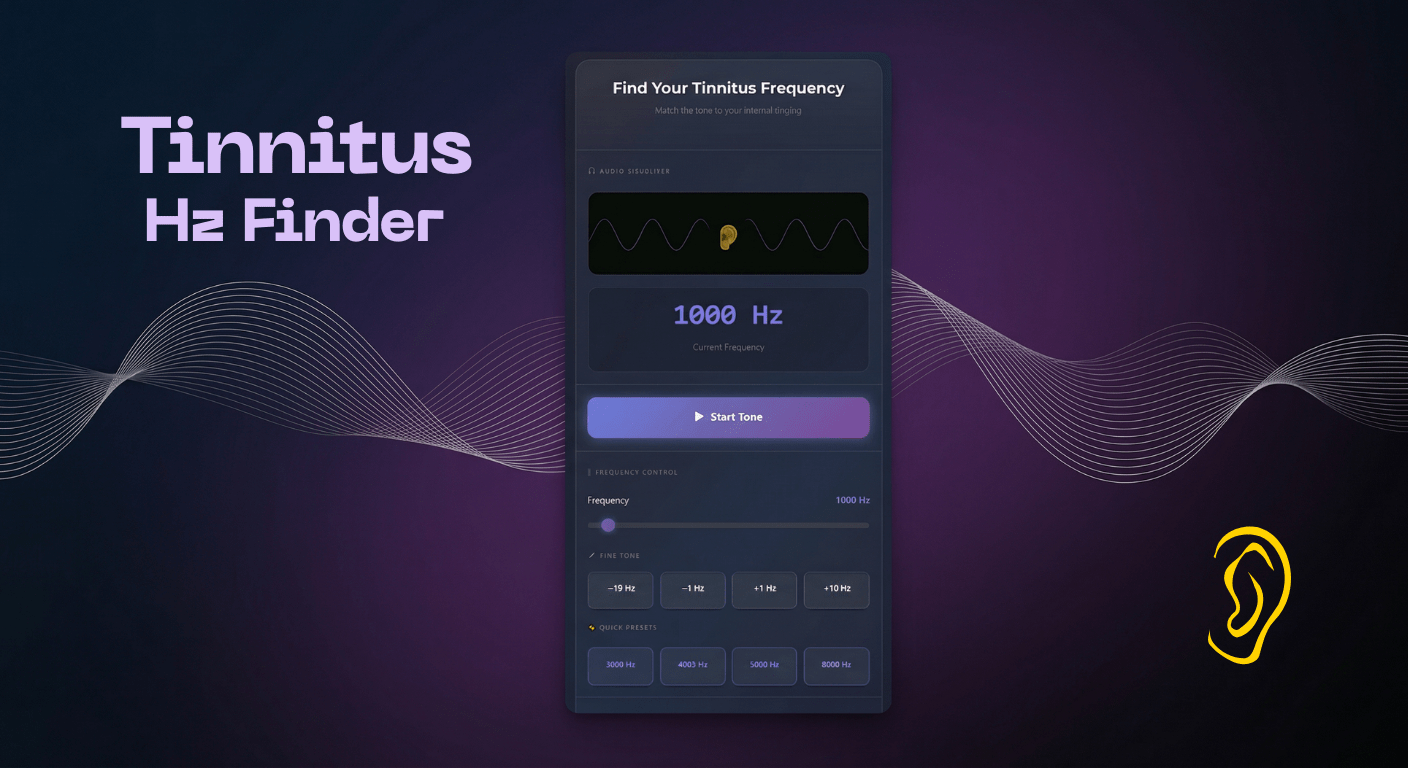
How to Use This Tinnitus Frequency Finder
-
Start with very low volume
Always begin at the lowest comfortable volume. -
Press “Start Tone”
You’ll hear a pure tone. -
Adjust the frequency slowly
Use the slider or fine-tune buttons until the tone feels closest to your tinnitus sound. -
Listen briefly
Match the pitch — not the loudness. -
Note your frequency
Most people fall between 2,000 Hz and 8,000 Hz, but this varies.
🔹 This tool provides an approximate reference, not a diagnosis.
Many people experience tinnitus differently, which is why finding a single “correct” sound is often confusing. Find Your Tinnitus Frequency Online is designed to help you gently explore and match the pitch of the ringing or buzzing you hear using simple tone adjustments.
This tinnitus frequency finder focuses on tinnitus frequency matching, allowing you to identify your tinnitus ringing frequency instead of guessing based on fixed numbers or names. It’s often said that understanding your tinnitus frequency first can make it easier to choose background sounds or noise that feels less intrusive.
This tool does not offer a cure, but it can help you better understand what you’re hearing and explore sound-based options, such as noise to cancel out tinnitus or sound masking, in a more informed and personal way.
What Your Tinnitus Frequency May Sound Like
Many people want to know if their experience is “normal.”
The table below shows common tinnitus frequency ranges and how they are often described.
| Frequency Range | Common Description | Typical Sensation |
|---|---|---|
| 125 – 500 Hz | Low hum or rumble | Engine, distant thunder |
| 500 – 2,000 Hz | Mid buzzing | Electrical or mechanical hum |
| 2,000 – 6,000 Hz | High ringing | Whistle, tea kettle |
| 6,000 – 12,000 Hz | Very sharp tone | Mosquito-like sound |
| 12,000+ Hz | Ultra-high pitch | Thin hiss or pressure |
📌 Many tinnitus cases fall into the higher frequency ranges, especially above 3,000 Hz.
Why Finding Your Tinnitus Frequency Helps
Knowing your tinnitus frequency can help you:
-
Understand the pitch of your tinnitus
-
Choose more suitable sound masking or noise
-
Communicate more clearly with an audiologist
-
Reduce anxiety by identifying the sound
It does not mean something is wrong with you — tinnitus pitch varies widely and is very common.
Important Safety Tips While Using Frequency Tools
-
Keep the volume as low as possible
-
Do not listen for long periods
-
Stop immediately if you feel discomfort
-
Take breaks between attempts
-
Use in a quiet environment
Your comfort and hearing safety always come first.
Can Sound Help With Tinnitus?
Many people use sound to make tinnitus less noticeable, especially in quiet environments.
This is often called sound masking.
Common options include:
-
Pink or brown noise
-
Nature sounds
-
Low-contrast background tones
Different sounds work for different people, depending on their tinnitus frequency.
Frequently Asked Questions
What is the most common tinnitus frequency?
Most people report tinnitus between 3,000 Hz and 8,000 Hz, but lower and higher frequencies are also possible.
Can a frequency generator cure tinnitus?
No. Frequency tools do not cure tinnitus, but they can help you understand and manage it.
Should I listen at high volume to match my tinnitus?
No. Tinnitus matching is about pitch, not loudness. Always keep volume low.
Is high-frequency tinnitus dangerous?
High-frequency tinnitus is very common and does not automatically mean hearing damage or a serious condition.
When should I see a doctor?
If tinnitus is:
-
Sudden
-
Only in one ear
-
Pulsing
-
Getting worse rapidly
You should consult a healthcare professional or audiologist.
Final Note
This tinnitus frequency finder is a self-help reference tool designed to give clarity and reduce uncertainty.
It is not a medical device and does not replace professional care.
This article is for educational purposes, not medical advice.
☸