Frequency Converter
Convert · Hear · Visualize · Compare
Convert frequencies between units, explore their relationships, hear audible tones, and visualize oscillations.
Frequency Converter
Live Frequency Wave
Frequency Information
Common Frequencies
Frequency → Wavelength
Frequency → Period
Session Notes
Download a PDF summarizing your current frequency exploration — useful for students, teachers, researchers, and personal notes.
Compare Frequencies
Classroom / Lab Mode
Formulas & Relationships
Frequency
Measured in hertz (Hz). One hertz equals one cycle per second.
Period
The duration of one complete cycle. Inversely related to frequency.
Wavelength
Depends on wave speed v in the chosen medium.
Unit prefixes
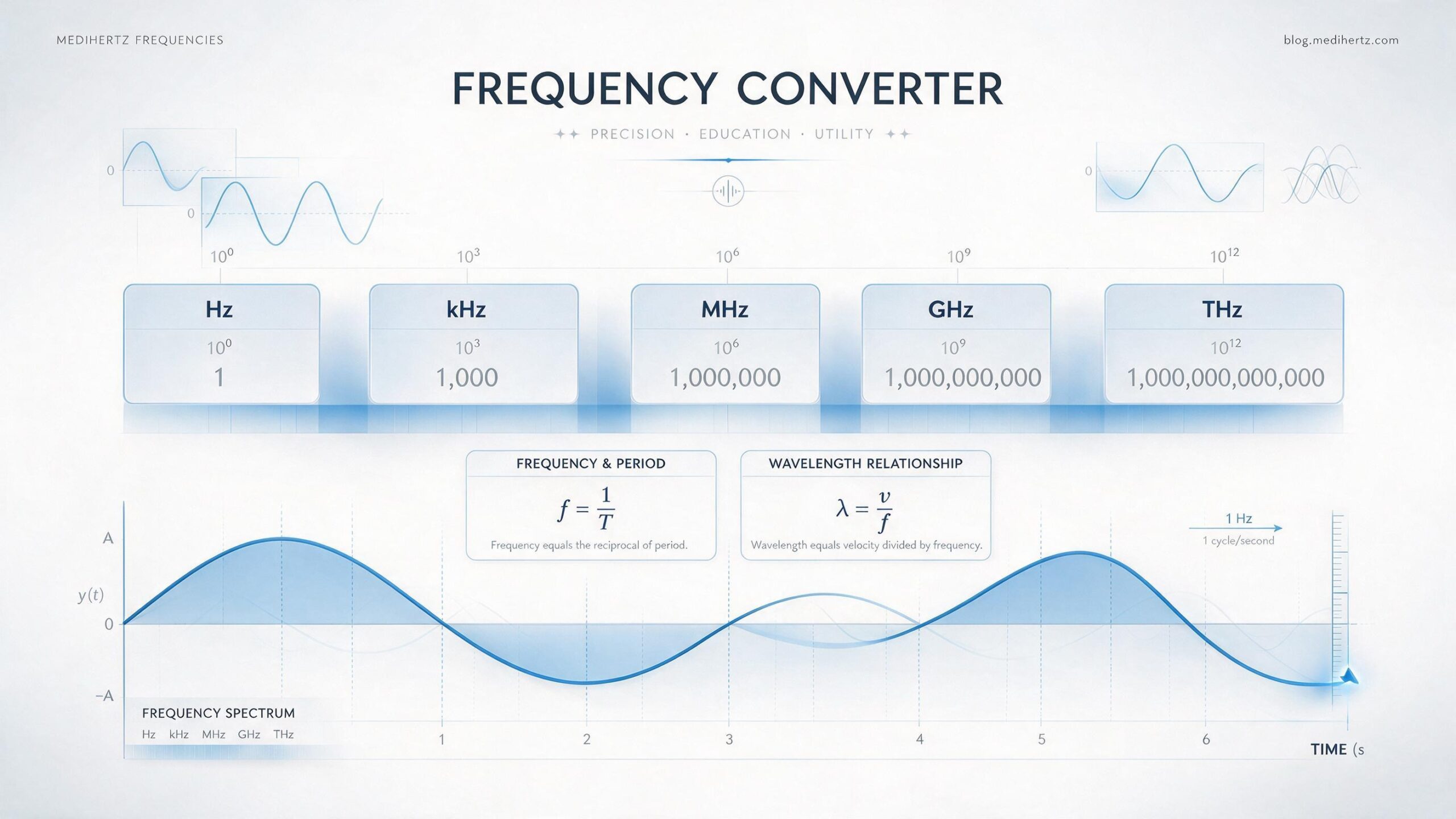
SI prefixes multiply the base unit (hertz) by powers of one thousand.
Relationship
As frequency increases, both period and wavelength decrease for a fixed medium.
Sound speed (approx.)
Speeds vary with temperature, humidity, pressure, and composition.
Explore More Medihertz Tools
Frequency Conversion Tables
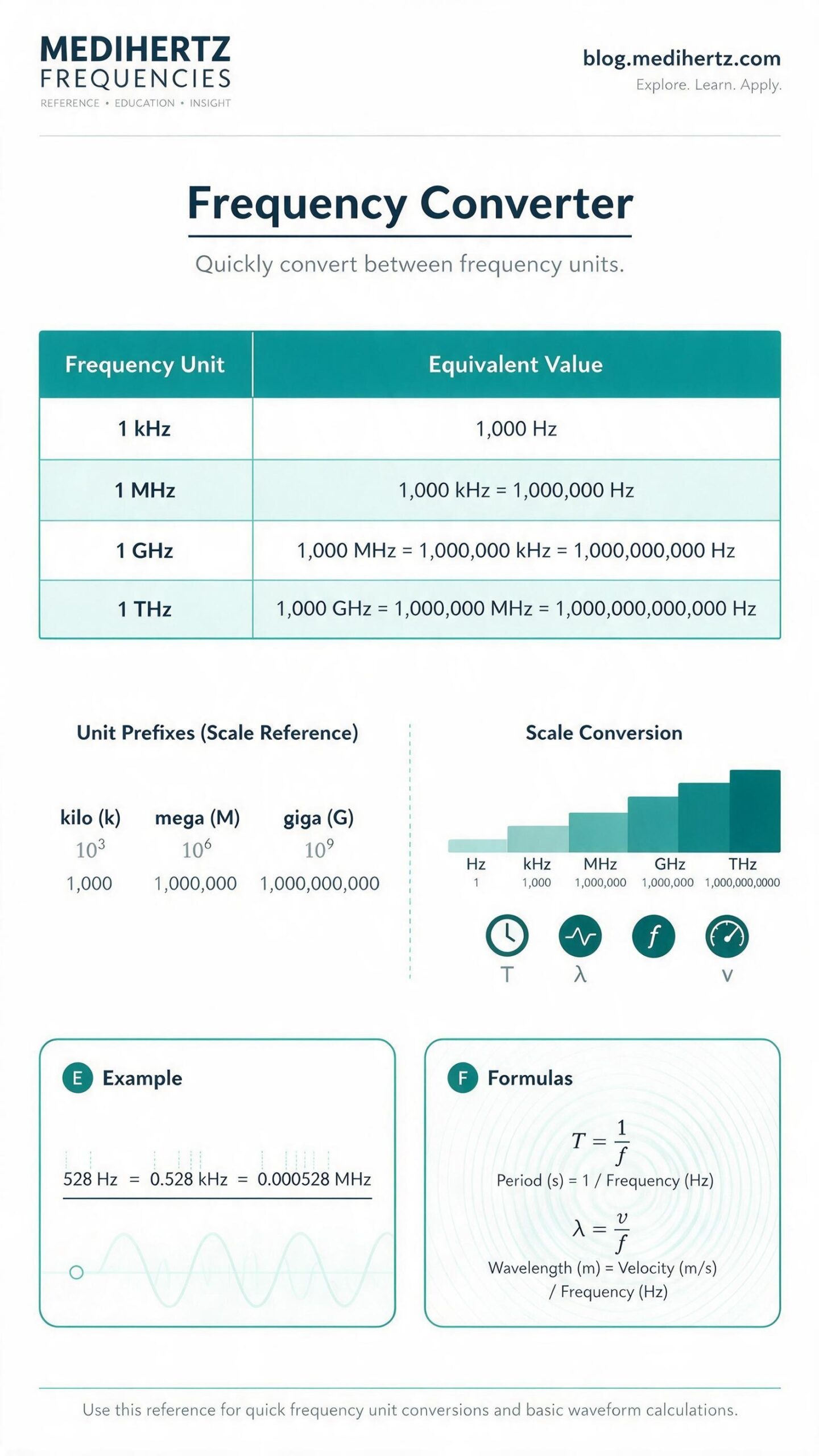
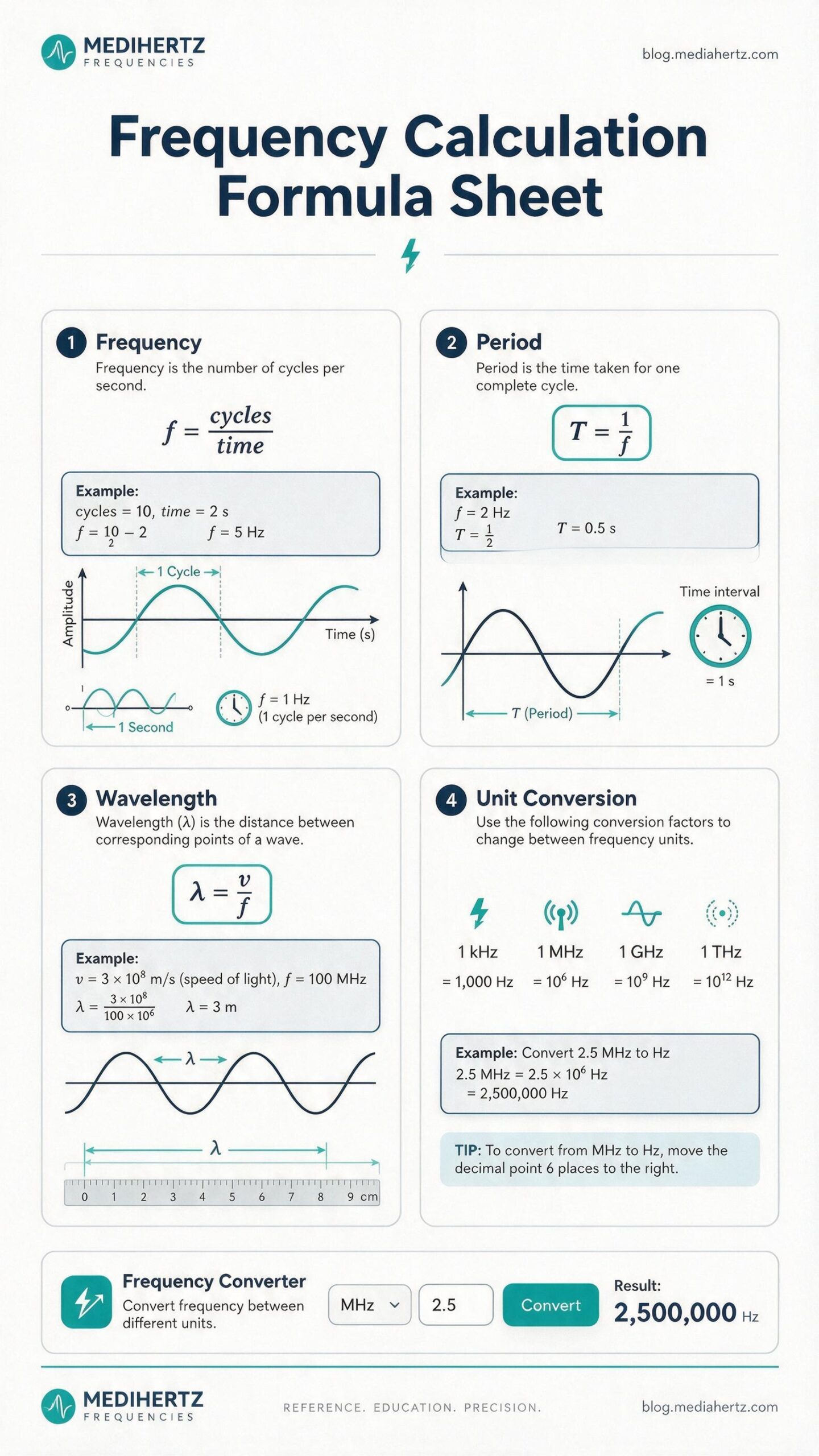
A frequency tells us how many complete cycles, vibrations, or oscillations occur in one second. The SI unit of frequency is Hertz (Hz).
Core Frequency Unit Conversion Chart
| Hertz (Hz) | Kilohertz (kHz) | Megahertz (MHz) | Gigahertz (GHz) | Terahertz (THz) |
|---|---|---|---|---|
| 1 Hz | 0.001 kHz | 0.000001 MHz | 0.000000001 GHz | 0.000000000001 THz |
| 10 Hz | 0.01 kHz | 0.00001 MHz | 0.00000001 GHz | 0.00000000001 THz |
| 20 Hz | 0.02 kHz | 0.00002 MHz | 0.00000002 GHz | 0.00000000002 THz |
| 50 Hz | 0.05 kHz | 0.00005 MHz | 0.00000005 GHz | 0.00000000005 THz |
| 100 Hz | 0.1 kHz | 0.0001 MHz | 0.0000001 GHz | 0.0000000001 THz |
| 200 Hz | 0.2 kHz | 0.0002 MHz | 0.0000002 GHz | 0.0000000002 THz |
| 400 Hz | 0.4 kHz | 0.0004 MHz | 0.0000004 GHz | 0.0000000004 THz |
| 432 Hz | 0.432 kHz | 0.000432 MHz | 0.000000432 GHz | 0.000000000432 THz |
| 440 Hz | 0.44 kHz | 0.00044 MHz | 0.00000044 GHz | 0.00000000044 THz |
| 500 Hz | 0.5 kHz | 0.0005 MHz | 0.0000005 GHz | 0.0000000005 THz |
| 528 Hz | 0.528 kHz | 0.000528 MHz | 0.000000528 GHz | 0.000000000528 THz |
| 639 Hz | 0.639 kHz | 0.000639 MHz | 0.000000639 GHz | 0.000000000639 THz |
| 741 Hz | 0.741 kHz | 0.000741 MHz | 0.000000741 GHz | 0.000000000741 THz |
| 852 Hz | 0.852 kHz | 0.000852 MHz | 0.000000852 GHz | 0.000000000852 THz |
| 1,000 Hz | 1 kHz | 0.001 MHz | 0.000001 GHz | 0.000000001 THz |
| 10,000 Hz | 10 kHz | 0.01 MHz | 0.00001 GHz | 0.00000001 THz |
| 20,000 Hz | 20 kHz | 0.02 MHz | 0.00002 GHz | 0.00000002 THz |
| 100,000 Hz | 100 kHz | 0.1 MHz | 0.0001 GHz | 0.0000001 THz |
| 1,000,000 Hz | 1,000 kHz | 1 MHz | 0.001 GHz | 0.000001 THz |
| 1,000,000,000 Hz | 1,000,000 kHz | 1,000 MHz | 1 GHz | 0.001 THz |
| 1,000,000,000,000 Hz | 1,000,000,000 kHz | 1,000,000 MHz | 1,000 GHz | 1 THz |
Frequency Unit Conversion Factors
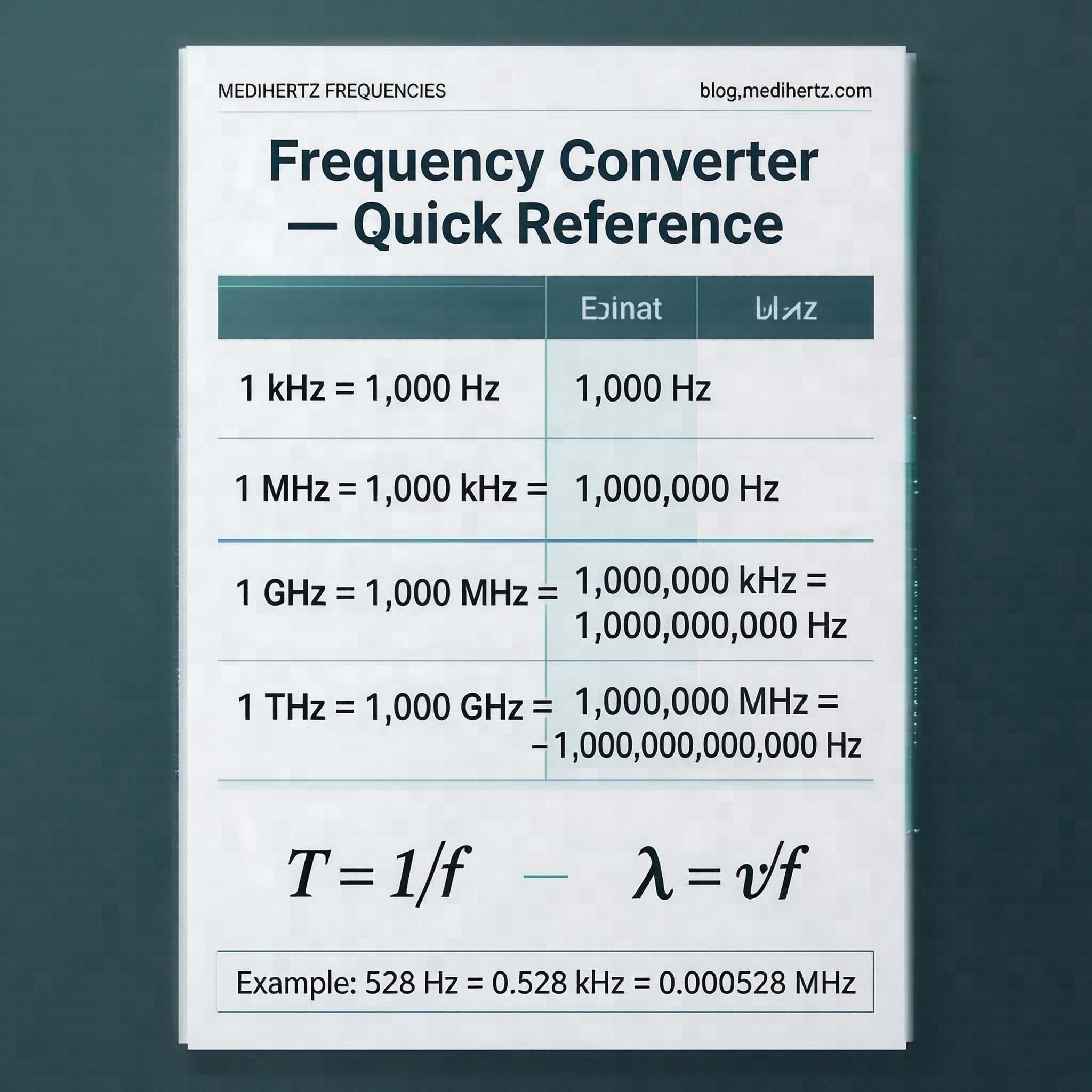
The easiest way to convert between frequency units is to remember these relationships:
| Conversion | Relationship |
|---|---|
| 1 kHz | 1,000 Hz |
| 1 MHz | 1,000 kHz |
| 1 MHz | 1,000,000 Hz |
| 1 GHz | 1,000 MHz |
| 1 GHz | 1,000,000 kHz |
| 1 GHz | 1,000,000,000 Hz |
| 1 THz | 1,000 GHz |
| 1 THz | 1,000,000 MHz |
| 1 THz | 1,000,000,000 kHz |
| 1 THz | 1,000,000,000,000 Hz |
Quick Rule
Moving to a smaller unit → multiply.
Moving to a larger unit → divide.
For example:
5 kHz → Hz
5 × 1,000 = 5,000 Hz
5,000 Hz → kHz
5,000 ÷ 1,000 = 5 kHz
Common Frequency Conversions
| Frequency | Equivalent |
|---|---|
| 1 Hz | 0.001 kHz |
| 10 Hz | 0.01 kHz |
| 20 Hz | 0.02 kHz |
| 40 Hz | 0.04 kHz |
| 100 Hz | 0.1 kHz |
| 200 Hz | 0.2 kHz |
| 432 Hz | 0.432 kHz |
| 440 Hz | 0.44 kHz |
| 528 Hz | 0.528 kHz |
| 1 kHz | 1,000 Hz |
| 5 kHz | 5,000 Hz |
| 10 kHz | 10,000 Hz |
| 20 kHz | 20,000 Hz |
| 100 kHz | 100,000 Hz |
| 1 MHz | 1,000,000 Hz |
| 10 MHz | 10,000,000 Hz |
| 100 MHz | 100,000,000 Hz |
| 1 GHz | 1,000,000,000 Hz |
| 2.4 GHz | 2,400,000,000 Hz |
| 5 GHz | 5,000,000,000 Hz |
| 10 GHz | 10,000,000,000 Hz |
| 1 THz | 1,000,000,000,000 Hz |
About the Medihertz Frequency Converter
The Medihertz Frequency Converter is an interactive frequency calculation and visualization tool designed to help you convert, understand, hear, and explore frequencies.
Instead of simply converting a number from Hz to kHz or MHz, the calculator connects frequency conversion with several useful concepts, including:
- Frequency units
- Period
- Cycles per second
- Approximate hearing range
- Audio frequency generation
- Waveform visualization
- Wavelength
- Frequency comparison
- Scientific formulas
- Classroom and laboratory calculations
You can enter a frequency such as 528 Hz, convert it into different units, calculate its period and wavelength, visualize its waveform, and—when appropriate—hear an audible representation.
How to Use the Frequency Converter
1. Enter a frequency
Enter any positive frequency into the main input.
For example:
528
2. Select the original unit
Choose the unit of your value:
- Hz
- kHz
- MHz
- GHz
- THz
For example:
528 Hz
3. Select the conversion unit
Choose the unit you want to convert to.
For example:
kHz
The calculator automatically displays:
528 Hz = 0.528 kHz
No manual calculation or submit button is required.
4. Use Swap
The Swap button exchanges the input and output units and recalculates the value automatically.
For example:
528 Hz → 0.528 kHz
can become:
0.528 kHz → 528 Hz
5. Try a common frequency
Use the quick-frequency buttons to explore commonly used example frequencies such as:
432 Hz, 440 Hz, 528 Hz, 1 kHz and 10 kHz.
These are provided as convenient examples and are not presented as medical or therapeutic recommendations.
What Is Frequency?
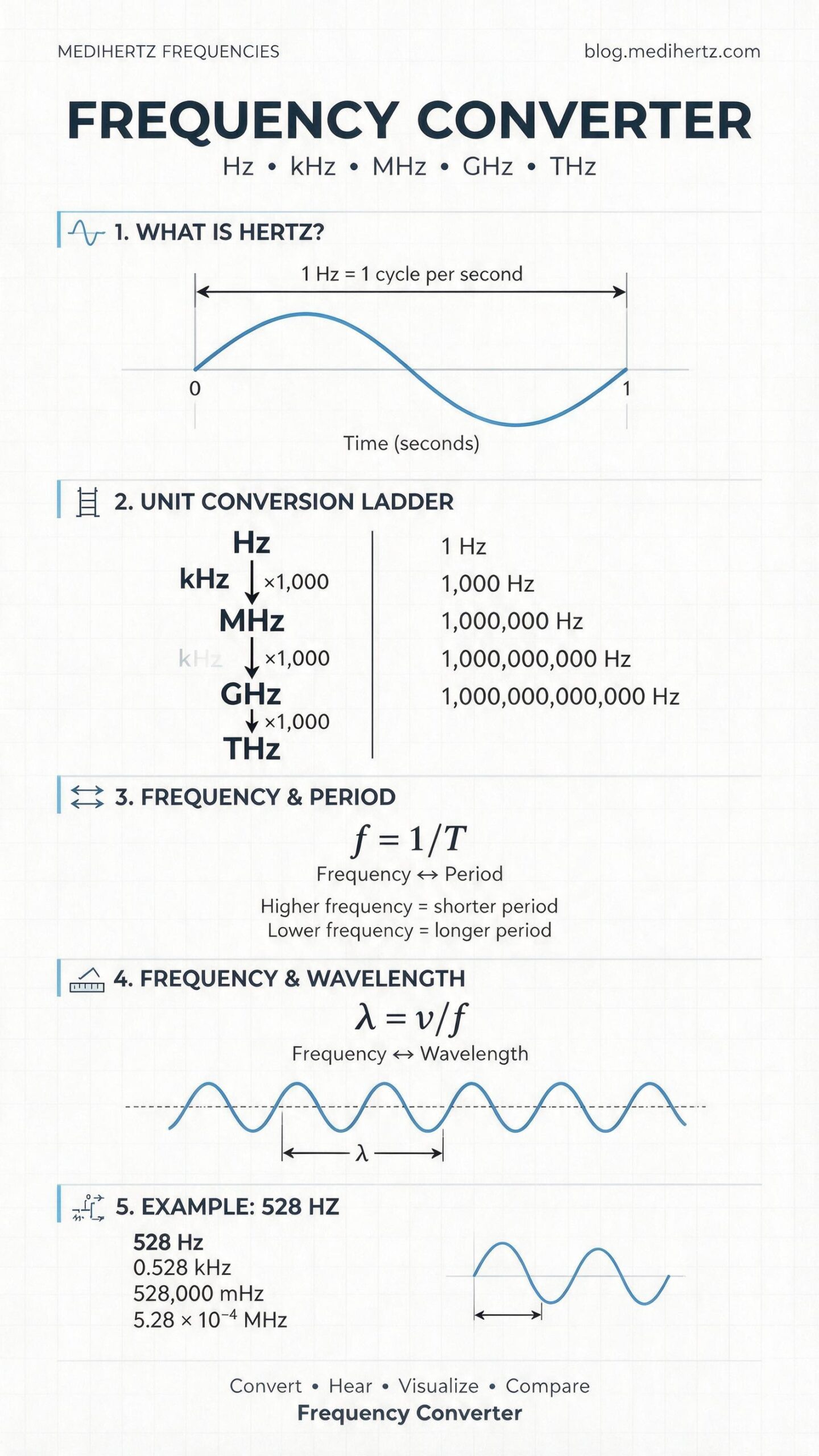
Frequency is the number of complete cycles or oscillations that occur per second.
The SI unit of frequency is the Hertz (Hz).
Therefore:
1 Hz = 1 cycle per second
If something completes 100 cycles every second, its frequency is:
100 Hz
If it completes 1,000 cycles every second:
1,000 Hz = 1 kHz
Frequency is used throughout science and technology, including:
- Acoustics
- Music
- Electronics
- Radio
- Telecommunications
- Physics
- Engineering
- Signal processing
- Electrical systems
- Wave studies
Frequency vs. Period
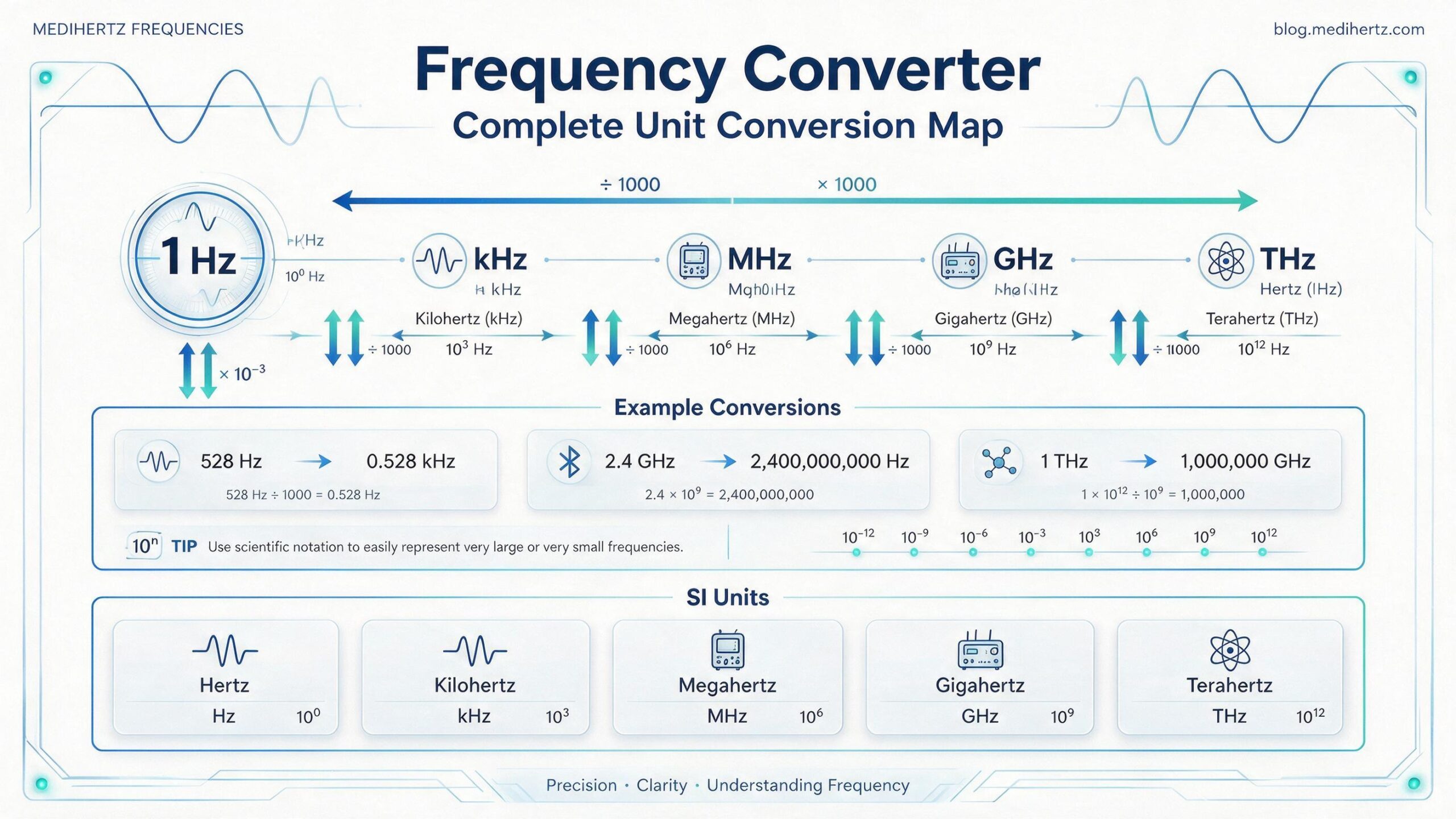
Frequency and period describe the same repeating process from two different perspectives.
Frequency tells you how many cycles occur per second.
Period tells you how much time one cycle takes.
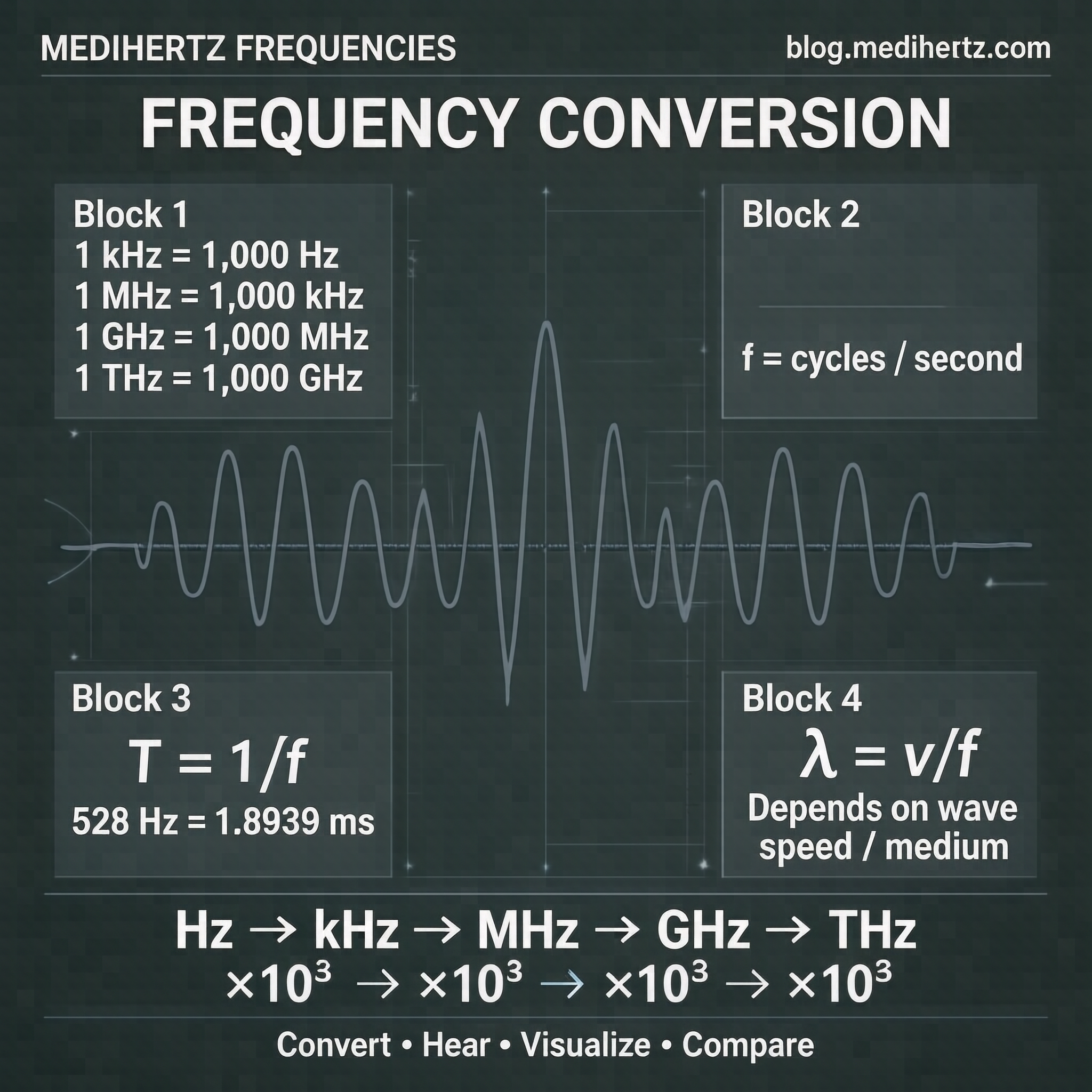
The relationship is:
T = 1 / f
Where:
- T = period
- f = frequency
For example:
528 Hz
has a period of approximately:
0.00189394 seconds
or:
1.89394 milliseconds
Important relationship
Higher frequency → shorter period
Lower frequency → longer period
Frequency and Cycles per Second
Hertz can be understood directly as cycles per second.
| Frequency | Cycles per second |
|---|---|
| 1 Hz | 1 |
| 10 Hz | 10 |
| 100 Hz | 100 |
| 440 Hz | 440 |
| 1 kHz | 1,000 |
| 10 kHz | 10,000 |
| 1 MHz | 1,000,000 |
| 1 GHz | 1,000,000,000 |
This makes Hz particularly useful for describing repeating signals and oscillations.
 Frequency and Human Hearing
For general educational purposes, the commonly referenced approximate range of human hearing is:
20 Hz – 20,000 Hz
However, this should not be interpreted as a precise limit for every person. Hearing ability varies with factors such as age, individual hearing characteristics, exposure to loud sound, equipment, and listening conditions.
The calculator therefore uses categories such as:
Below typical hearing range
Below approximately 20 Hz
Within typical hearing range
Approximately 20 Hz–20 kHz
Above typical hearing range
Above approximately 20 kHz
The calculator should not be interpreted as a hearing test.
Can Every Frequency Be Heard?
No.
A frequency can exist mathematically or physically without being directly audible to a particular listener.
For example:
7.83 Hz
is below the commonly referenced typical human hearing range.
The calculator therefore distinguishes between the original frequency and any audible demonstration frequency used for exploration.
An audible demonstration does not mean that the original low-frequency signal has suddenly become audible.
Frequency and Wavelength
Frequency is also related to wavelength.
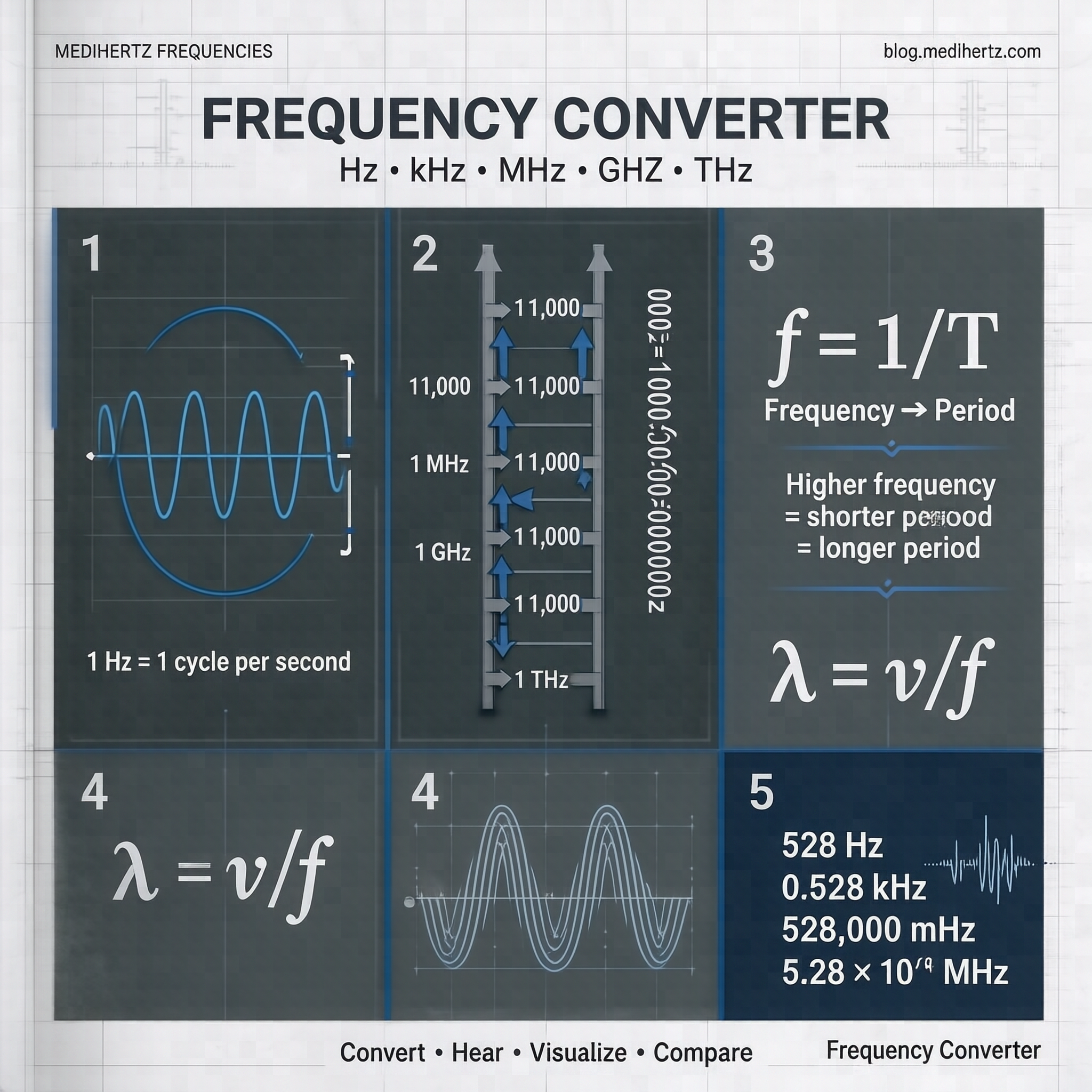
The basic relationship is:
λ = v / f
Where:
- λ = wavelength
- v = propagation speed
- f = frequency
This means wavelength depends not only on frequency but also on the medium through which the wave travels.
For sound in air, for example, the propagation speed is approximately 343 m/s under commonly used reference conditions.
At 528 Hz, using 343 m/s as the assumed speed:
λ ≈ 343 / 528
λ ≈ 0.650 m
So the wavelength is approximately:
65 cm
The exact value can vary with conditions such as temperature because the speed of sound in air changes.
Why Does Medium Matter?
The same frequency can have different wavelengths in different media because wave speed changes.
The calculator therefore allows you to select a medium such as:
- Air
- Water
- Vacuum
- Custom speed
For a given frequency:
Higher wave speed → longer wavelength
Lower wave speed → shorter wavelength
This is particularly useful when studying wave propagation in physics and engineering.
Frequency Conversion Examples
Hz to kHz
Convert 2,500 Hz to kHz:
2,500 ÷ 1,000 = 2.5 kHz
kHz to Hz
Convert 2.5 kHz to Hz:
2.5 × 1,000 = 2,500 Hz
MHz to Hz
Convert 5 MHz to Hz:
5 × 1,000,000 = 5,000,000 Hz
GHz to MHz
Convert 2.4 GHz to MHz:
2.4 × 1,000 = 2,400 MHz
GHz to Hz
Convert 2.4 GHz to Hz:
2.4 × 1,000,000,000 = 2,400,000,000 Hz
THz to Hz
Convert 1 THz to Hz:
1 × 1,000,000,000,000 = 1,000,000,000,000 Hz
Common Frequency Units Explained
Hertz (Hz)
The fundamental SI unit of frequency.
1 Hz = 1 cycle per second
Kilohertz (kHz)
One thousand Hertz.
1 kHz = 1,000 Hz
Commonly encountered in audio and electronics.
Megahertz (MHz)
One million Hertz.
1 MHz = 1,000,000 Hz
Commonly encountered in electronics, radio, processors and communication systems.
Gigahertz (GHz)
One billion Hertz.
1 GHz = 1,000,000,000 Hz
Commonly encountered in wireless communication, processors and other high-frequency electronic systems.
Terahertz (THz)
One trillion Hertz.
1 THz = 1,000,000,000,000 Hz
THz frequencies are used in areas of physics, spectroscopy, imaging and other high-frequency technologies.
Frequency in Audio
Audio signals can be described using frequency, amplitude and other characteristics.
Frequency is closely associated with the perceived pitch of a periodic sound, while amplitude is related to its level or strength.
For example:
440 Hz is commonly used as the reference frequency for the musical note A4 in standard tuning.
Changing frequency changes the pitch of a generated tone.
The Medihertz calculator allows users to explore this relationship using its audio functionality.
Important: Listening volume should always be kept at a comfortable, safe level.
What Is a Waveform?
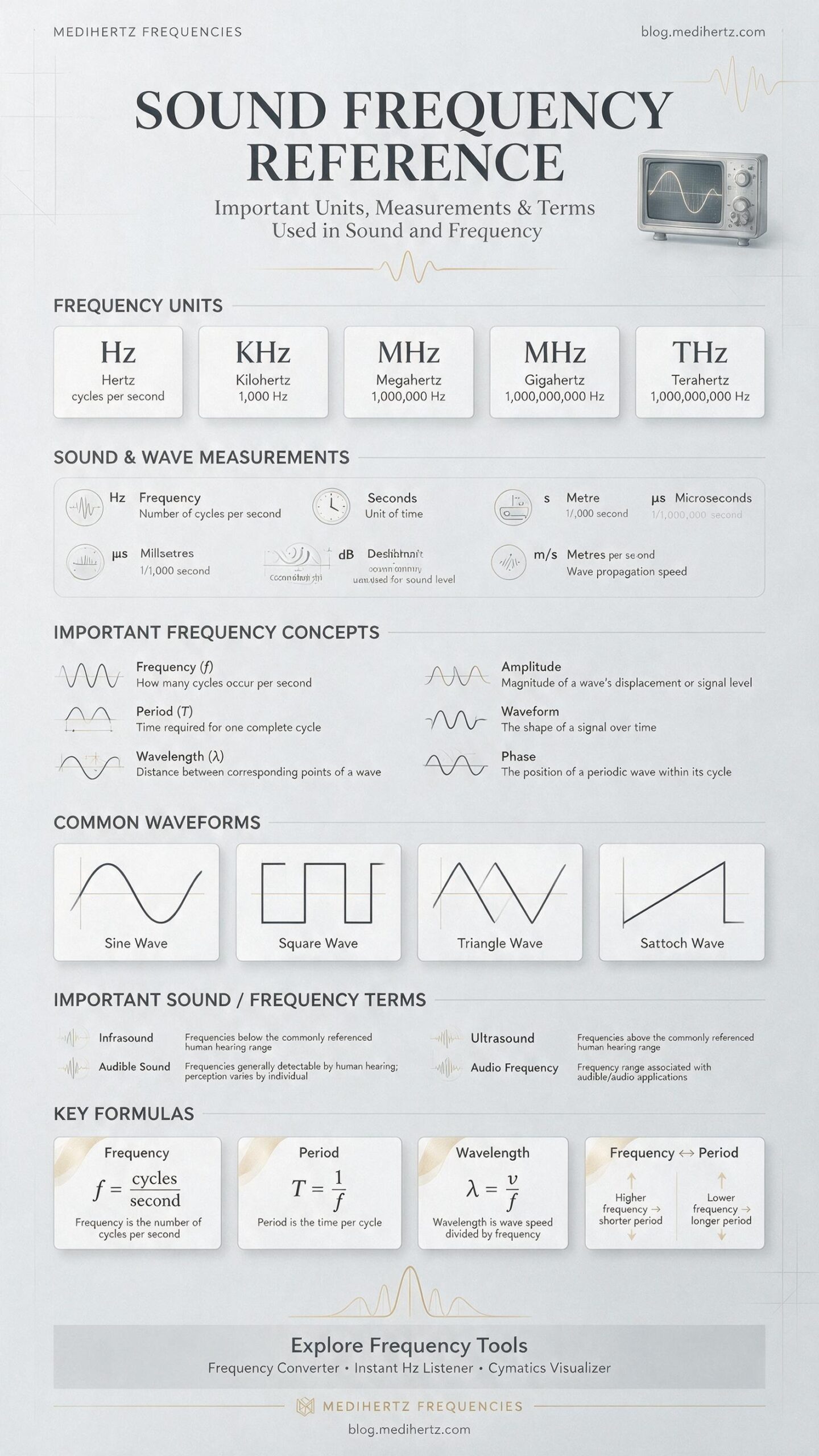
A waveform is a visual representation of how a signal changes over time.
The Frequency Converter can visualize several common waveform shapes:
- Sine
- Square
- Triangle
- Sawtooth
Sine wave
The smoothest basic periodic waveform and one of the fundamental building blocks used to describe periodic signals.
Square wave
Alternates between two primary levels and contains many harmonic components.
Triangle wave
Rises and falls linearly between its peak levels.
Sawtooth wave
Rises or falls progressively before resetting, depending on its orientation.
The waveform shape describes the signal’s form; frequency describes how rapidly that pattern repeats.
Frequency Comparison
When comparing two frequencies, several useful quantities can be calculated.
For example:
Frequency A: 432 Hz
Frequency B: 528 Hz
The calculator can show:
- Difference
- Ratio
- Period A
- Period B
- Wavelength A
- Wavelength B
This can be useful when studying how changing frequency affects period and wavelength.
It does not imply that one frequency is inherently better than another.
Useful Frequency Formulas
Frequency
f = cycles / time
For one-second intervals:
f = cycles per second
Period
T = 1 / f
Wavelength
λ = v / f
Frequency conversion
1 kHz = 1,000 Hz
1 MHz = 1,000,000 Hz
1 GHz = 1,000,000,000 Hz
1 THz = 1,000,000,000,000 Hz
Quick Reference: Frequency Scale
| Unit | Symbol | Number of Hertz |
|---|---|---|
| Hertz | Hz | 1 |
| Kilohertz | kHz | 1,000 |
| Megahertz | MHz | 1,000,000 |
| Gigahertz | GHz | 1,000,000,000 |
| Terahertz | THz | 1,000,000,000,000 |
A simple way to remember the scale is:
Hz → kHz → MHz → GHz → THz
Each step upward represents a multiplication factor of:
1,000
Frequently Asked Questions
How do I convert Hz to kHz?
Divide the frequency in Hertz by 1,000.
Example:
5,000 Hz ÷ 1,000 = 5 kHz
How do I convert kHz to Hz?
Multiply the value in kHz by 1,000.
Example:
5 kHz × 1,000 = 5,000 Hz
How many Hz are in 1 MHz?
1 MHz = 1,000,000 Hz.
How many Hz are in 1 GHz?
1 GHz = 1,000,000,000 Hz.
How many Hz are in 1 THz?
1 THz = 1,000,000,000,000 Hz.
What is the formula for frequency?
Frequency can be expressed as:
f = cycles / time
For a repeating cycle, frequency and period are related by:
f = 1 / T
What is the formula for period?
T = 1 / f
How do I calculate wavelength from frequency?
Use:
λ = v / f
You need both the frequency and the propagation speed of the wave.
Can I hear every frequency I enter?
No. The calculator distinguishes frequencies below, within, and above the approximate typical human hearing range. Hardware and individual hearing ability also affect what can actually be heard.
What is 440 Hz?
440 Hz is commonly used as the reference frequency for A4 in standard musical tuning.
What is 528 Hz?
528 Hz is simply a frequency value that can be entered, converted, visualized, compared, and explored using the calculator. The tool does not make medical or therapeutic claims about it.
Educational Note
Frequency calculations are mathematical relationships. The results produced by this calculator depend on the values and assumptions entered by the user.
For wavelength calculations, remember that wave speed depends on the medium and physical conditions. For sound, for example, the speed of propagation differs between air, water and other materials.
For audio experiments, keep playback volume low and avoid prolonged exposure to loud sounds.
Medihertz Frequencies provides this calculator for educational, experimental and informational use. It is not a medical diagnostic or treatment tool.
☸