
Medihertz Frequencies [Mhz]
〰 Your Sound Frequency Hub for Mind & Awareness
〰 Your Sound Frequency Hub for Mind & Awareness
Just a moment!
Choose a world and let's play together!
Hear a sample with the selected voice.
Voices come from your browser's built-in speech engine. Quality varies by device. For best results use Chrome on desktop or Android.
Provider: Web Speech API
Note: This is a client-side fallback. A production deployment could connect a server-side TTS provider for studio-quality audio, but that requires backend credentials.
Each letter has a picture and a sound.
Hint: A furry pet
Tap a story to start reading.
Flip the cards to find matching pairs.
Medihertz Little Learners is a free educational tool. Progress is stored locally. No personal information is collected. This tool does not treat or cure dyslexia.
0.05
Play • Listen • Discover • Learn
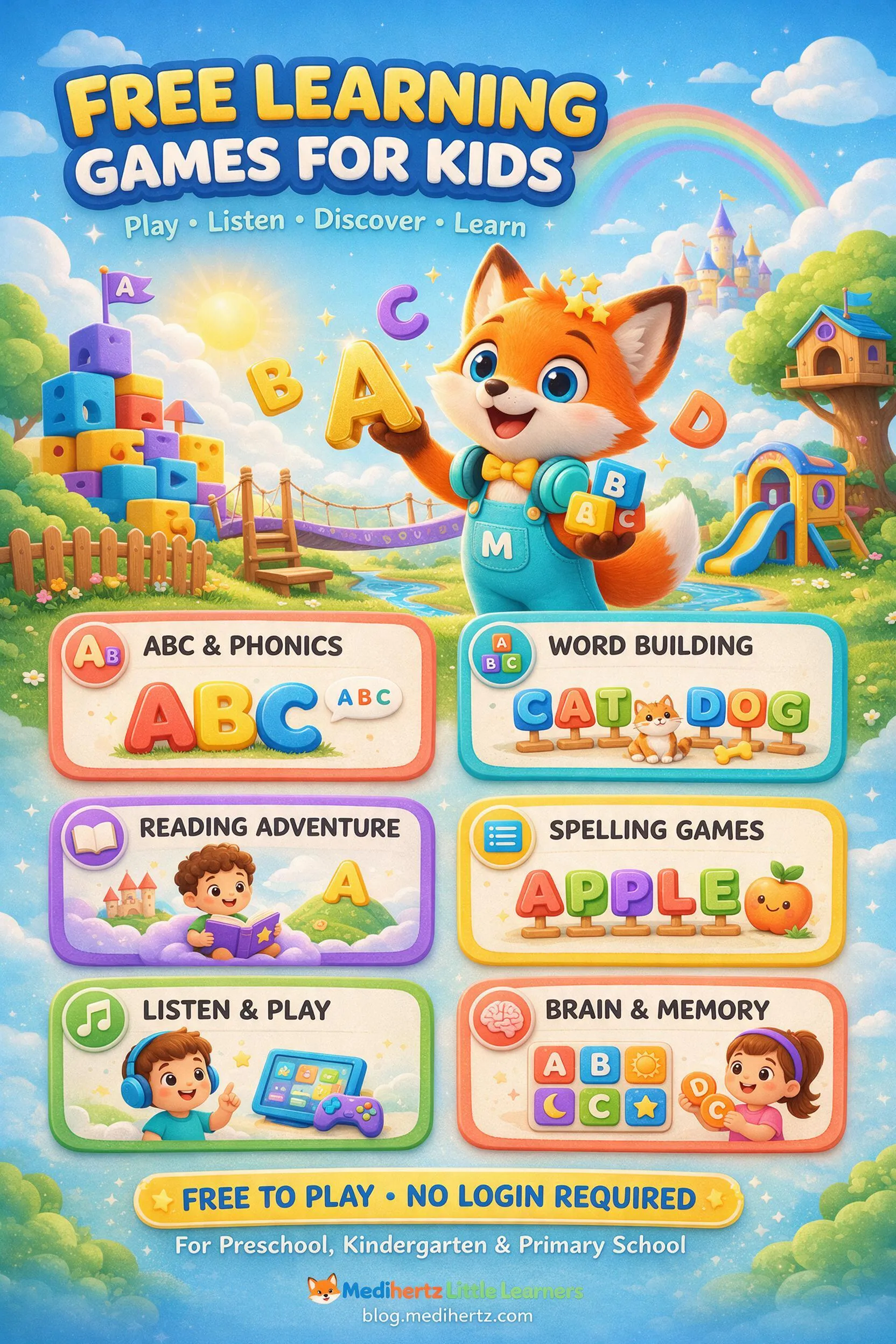
Give your child a fun place to explore letters, sounds, words, reading and spelling. Medihertz Little Learners is a free online learning playground with interactive educational games for preschool children, kindergarten learners and primary school students.
Children can discover the alphabet, listen to letter sounds, build simple words, enjoy reading adventures, solve spelling puzzles and play memory games through colourful, easy-to-use activities.
Whether you are a parent looking for free learning games at home, a teacher searching for interactive classroom activities, or a family exploring early reading skills, Little Learners makes learning feel like play.
Free to play. No login required. No account needed.
Children learn in different ways. Some enjoy pictures, some learn by listening, and others understand new ideas better when they can touch, move and explore.
Little Learners brings these experiences together in one child-friendly learning space.
Your child can:
The activities are designed to make practice enjoyable, with simple instructions, friendly visuals and positive feedback.
Phonics helps children understand how letters and groups of letters connect with the sounds in spoken words. It is an important part of early reading and spelling practice.
With interactive phonics games, your child can explore letters, recognise sounds, listen to words and discover how sounds come together to form words.
Little Learners offers playful activities for:
These activities can be useful for children who are just beginning to recognise letters as well as young learners who are ready to practise reading simple words.
Start with the ABCs. Children can explore uppercase and lowercase letters, listen to letter names and sounds, and connect letters with familiar objects and pictures.
This world supports alphabet recognition, letter-sound awareness and early phonics practice.
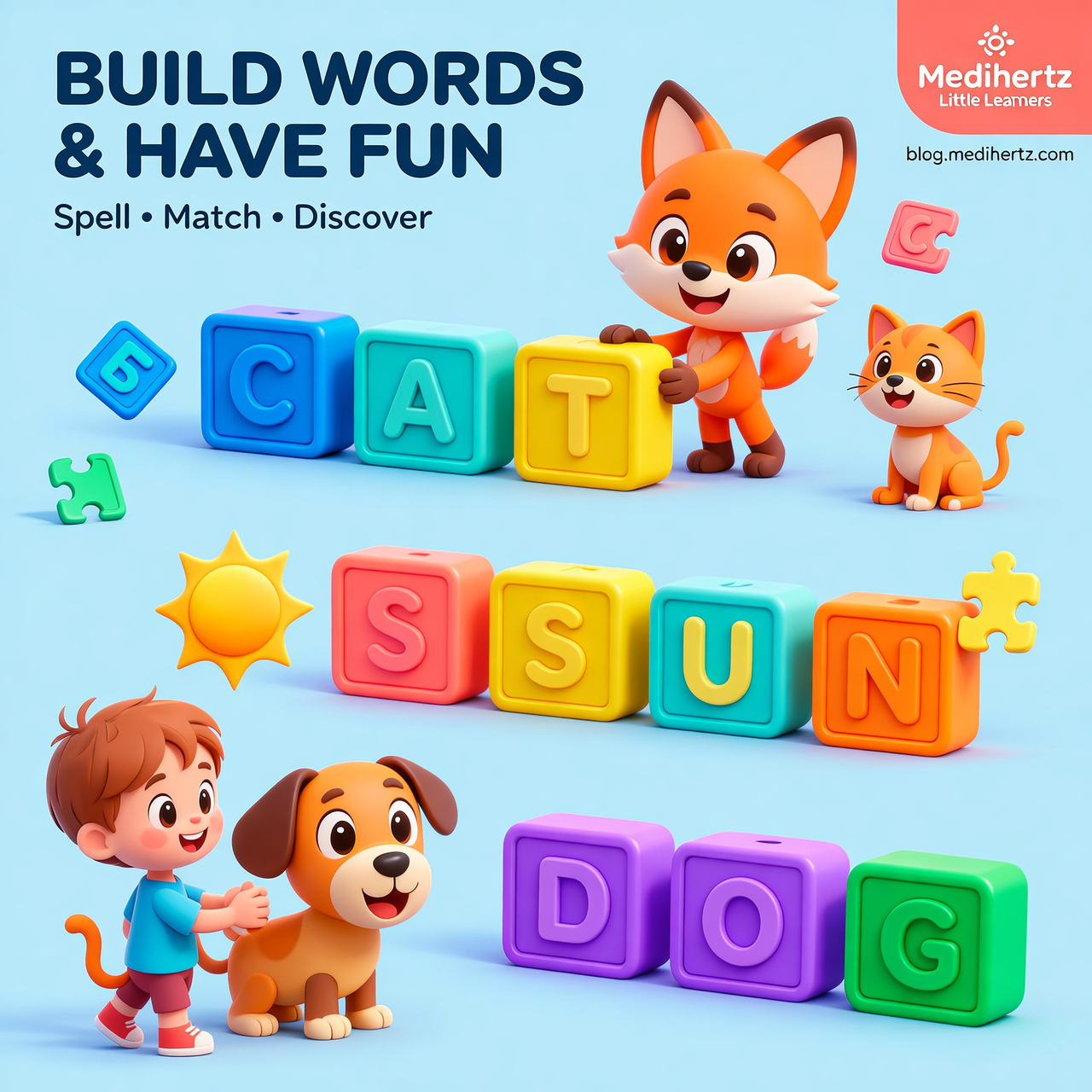
Turn letters into words through interactive word-building activities.
Children can arrange letters, complete missing-letter puzzles and match words with pictures. Simple examples such as CAT, DOG, SUN and FISH help introduce the connection between letters, sounds and words.
Make reading time more interactive with short stories and listening activities.
Children can follow a story, listen to narration, revisit sentences and answer simple comprehension questions. It gives early readers an enjoyable way to explore words, sentences and story meaning.
Let children become little word detectives.
They can discover missing letters, arrange scrambled letters, use picture clues and practise spelling familiar words. These activities encourage careful observation, word recognition and spelling practice.
Learning begins with listening.
Children can explore rhyming words, beginning and ending sounds, sound differences and syllable activities. Listening games encourage children to notice the sounds and patterns that make up spoken language.
Give young minds a playful challenge with picture matching, memory cards, patterns, sequences and observation games.
These activities encourage attention, visual recognition, memory and problem-solving through simple games.
Little Learners can be explored by children at different early learning stages. Every child develops at their own pace, so the suggested age groups are a starting point rather than a strict rule.
Little Explorers — Ages 3–5
A playful introduction to letters, pictures, sounds, listening and simple matching activities.
Word Builders — Ages 5–7
Explore phonics, alphabet sounds, simple words, rhyming, beginning sounds and early spelling.
Reading Stars — Ages 7–9
Practise word building, reading, spelling, stories, vocabulary and comprehension.
Word Masters — Ages 9–12
Explore more challenging word activities, spelling puzzles, reading challenges and memory games.
Parents and teachers can choose activities according to a child’s current skills and interests rather than age alone.
Children can have different reading and learning needs. Some may find letter recognition, spelling, reading or remembering letter patterns more challenging than others.
Little Learners aims to provide a supportive learning environment with features that can make practice more comfortable, including:
These options may be useful for children who prefer additional listening, visual or reading support, including some children with dyslexia.
An important note for parents: Dyslexia is a specific learning difference, and children benefit from support that matches their individual needs. Little Learners is an educational practice tool, not a dyslexia screening, diagnosis or treatment programme. It does not replace professional assessment, specialist teaching or structured literacy instruction.
Looking for free educational games for your child? Little Learners gives you one place to explore alphabet games, phonics activities, reading practice, spelling puzzles and memory games.
You can use it during short learning sessions at home, after school or as an enjoyable activity together. Sit with your child, listen to the words, ask questions and celebrate each new discovery.
Looking for interactive learning games for preschool or kindergarten?
Little Learners can be used as an additional digital activity for introducing letters, practising sounds, matching pictures, building simple words and encouraging listening skills.
Teachers can use suitable activities during supervised classroom sessions, small-group practice or learning stations.
Use reading, spelling, word-building and listening activities as supplementary practice for young learners.
The games can add variety to literacy lessons and give children another way to revisit familiar concepts.
If you teach your child at home, Little Learners can be an enjoyable addition to your early literacy routine.
Combine short game sessions with reading books, writing letters, speaking together and everyday word activities.
Children around the world grow up speaking and learning in different languages. A familiar language can help a child feel more comfortable while exploring new words and sounds.
Little Learners is designed with multilingual learning in mind. Where language options are available, parents and teachers can select a suitable language for the learning experience.
This can help families and classrooms explore early learning activities across different language backgrounds.
Language availability may vary by activity. Letter sounds and pronunciation can also differ between languages, so activities should be used with the appropriate language selected.
You can start exploring Medihertz Little Learners without creating an account.
There is no need to install a separate learning app just to begin exploring the games. Open the learning playground and choose an activity.
A few enjoyable minutes of practice can give children another opportunity to explore letters, sounds and words.
Try a simple routine:
Keep activities relaxed and follow your child’s interest. Celebrate curiosity, effort and small achievements. Real books, conversations, handwriting and interaction with parents and teachers remain important parts of learning.
Every letter can become a discovery. Every word can become a little achievement.
Explore Medihertz Little Learners and give your child a fun way to practise alphabet sounds, phonics, reading, spelling, listening and memory skills.
Free learning games for kids. No login. Just play, listen, discover and learn.
Medihertz Little Learners offers free interactive phonics, ABC, alphabet, reading, spelling, word-building, listening and memory games. Children can learn through pictures, sounds, stories and playful activities without needing to create an account.
Yes. Little Learners includes activities for preschoolers, kindergarten students and primary school children. Suggested age groups range from 3 to 12 years, with activities for alphabet recognition, letter sounds, early reading, spelling and word formation.
Little Learners includes audio-supported activities, repeated listening, picture clues and readable learning content that may help children who need additional reading and spelling practice, including some children with dyslexia. It is a supplementary educational resource, not a dyslexia treatment or replacement for specialist teaching.
Yes. Parents, kindergarten teachers, primary school teachers and homeschooling families can use Little Learners as an additional learning resource at home or in supervised classroom activities. It is currently free to access and does not require login or registration.
Little Learners is designed for supported mobile phones, tablets and computers. It is also designed with multilingual learning in mind. Available languages and pronunciation features depend on the language options currently supported by the platform.
☸