
Microphone measures airborne sound — not direct mechanical vibration.
What is resonance?
Resonance occurs when an object vibrates most strongly at certain frequencies, called natural frequencies. These depend on shape, thickness, material, and how the object is supported.
Generated tone vs. measured resonance
Generated audio is the signal we play through your speakers. Measured resonance requires a sensor (like a microphone) to capture the object's actual acoustic response. This tool labels them separately.
Why sweep?
A frequency sweep plays a range of tones. By listening and observing, you may find frequencies where the glass seems to respond more. A peak in the microphone spectrum is a candidate acoustic peak, not proof of mechanical resonance.
All experiments are illustrative and exploratory.
Glass Resonance Frequency: How Sound Makes Glass Vibrate
Have you ever tapped a glass and heard it produce a clear ringing sound? That sound is more than a simple noise. It reveals how an object responds to vibration.
The glass resonance frequency is an important part of this behaviour. Every glass object has physical properties that influence how it vibrates and produces sound. Its shape, thickness, dimensions, material and mounting conditions all affect its acoustic response.
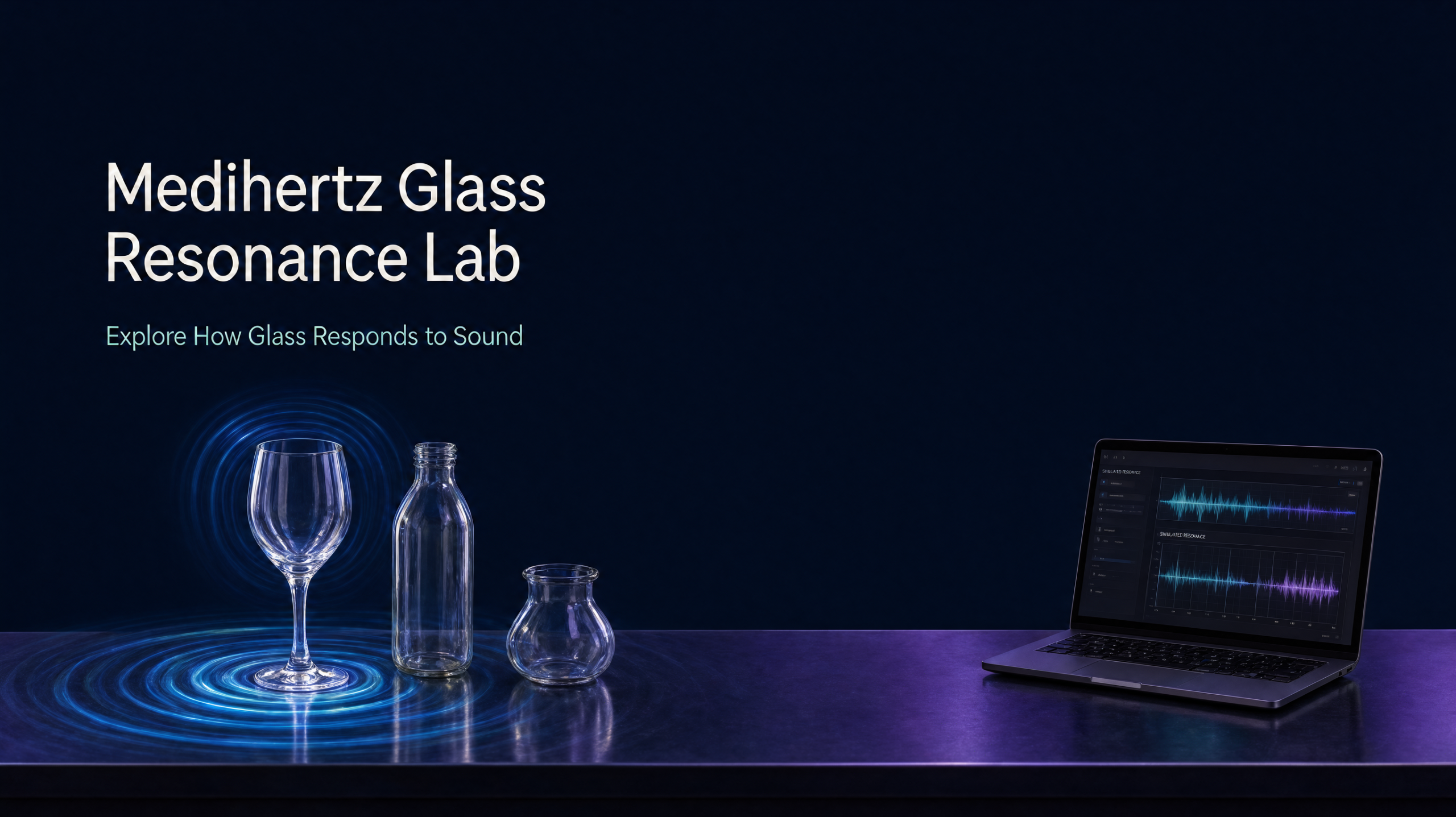
With the Medihertz Glass Resonance Lab, you can explore sound frequencies, experiment with different audio timbres, investigate frequency sweeps and learn how glass responds to sound. The tool is designed for curious learners, science enthusiasts, sound designers and anyone interested in the relationship between sound and physical objects.
Explore the Medihertz Glass Resonance Lab: [Open the interactive tool — INSERT YOUR TOOL URL]
What Is Glass Resonance Frequency?
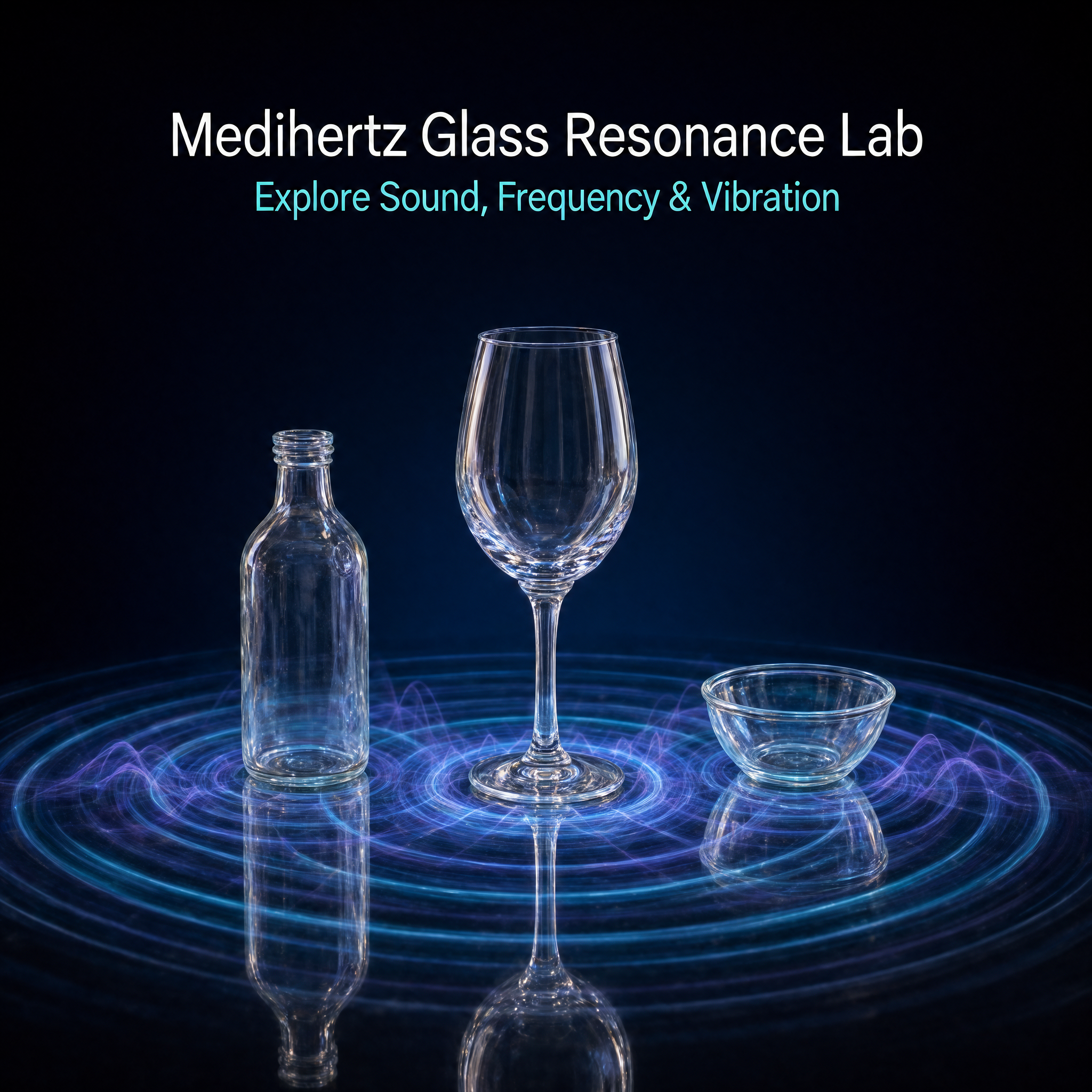
Glass resonance frequency refers to a frequency associated with a resonant vibration mode of a glass object.
When an external force or sound excites an object near one of its natural vibration frequencies, the object’s response can become stronger. This phenomenon is called resonance.
A glass does not have just one universal resonance frequency. Different vibration modes may occur at different frequencies, and the response depends on the object’s physical characteristics.
For example, a wine glass, a drinking tumbler, a glass bottle and a flat glass panel can respond differently to the same sound signal.
A research study of wineglass acoustics examined how natural resonant frequencies vary between vessels, including the effects of different amounts of liquid. This illustrates why the complete object matters, rather than the material name alone. Read about the study of wineglass acoustics.
What Frequency Does Glass Resonate At?
There is no single frequency at which all glass resonates.
The resonant frequency of a particular glass depends on several factors:
- Shape: A curved vessel and a flat panel have different vibration characteristics.
- Dimensions: Height, diameter, length and overall geometry affect the available vibration modes.
- Thickness: Changes in wall or panel thickness can change the resonant response.
- Material properties: Different glass formulations can have different mechanical properties.
- Mounting and support: Holding, resting or clamping a glass changes its boundary conditions.
- Liquid contents: Liquid inside a vessel can alter its mass and acoustic behaviour.
- Temperature and condition: Environmental conditions and existing defects may also influence measurements.
This is why searching for a single glass resonance frequency may not give you the correct answer for your own object.
The most useful approach is to examine the specific sample and measure its response under controlled conditions.
How Does Sound Make Glass Vibrate?
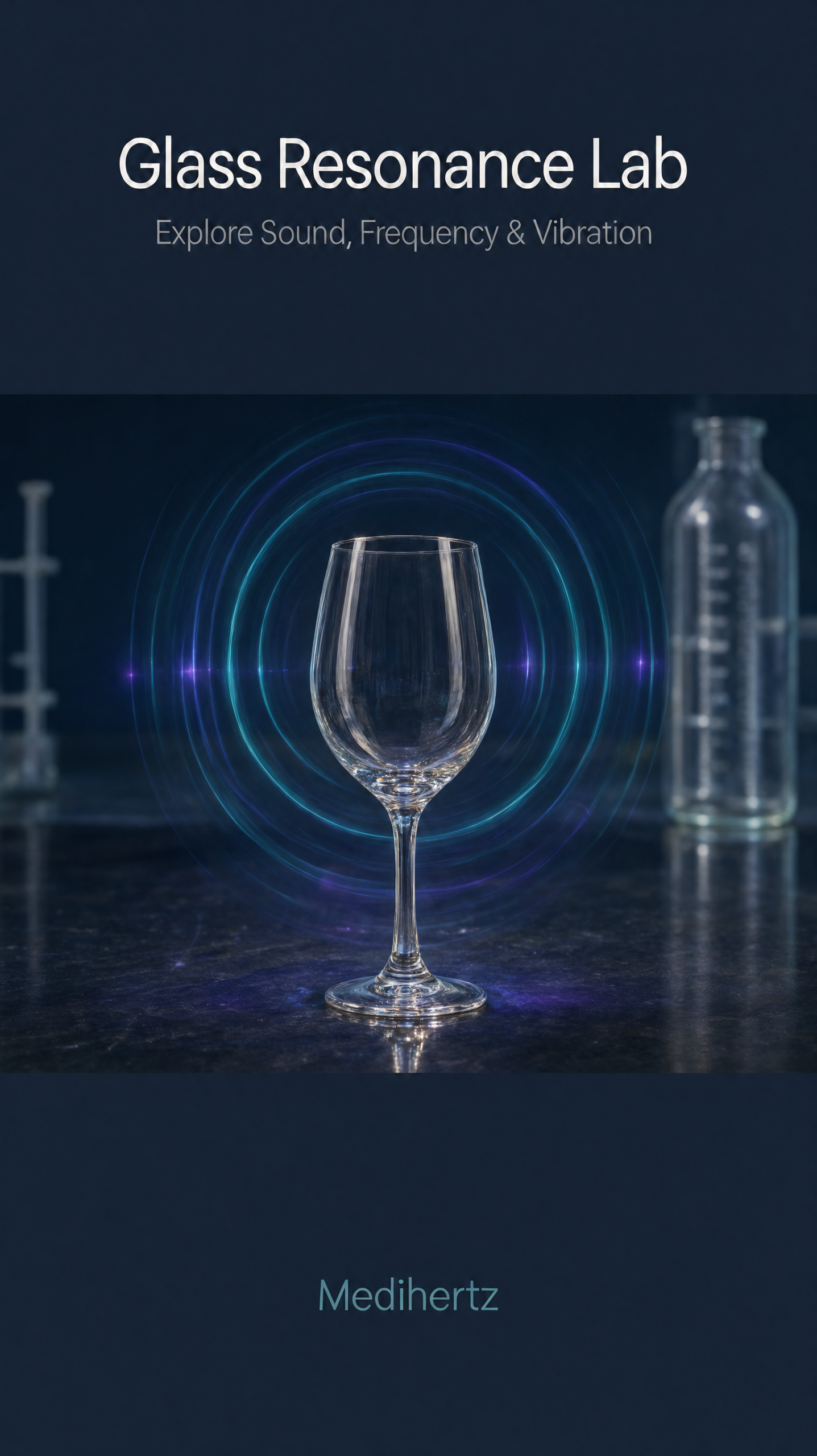
Sound travels through the air as pressure variations. When these variations reach a glass object, they can transfer energy to it and cause small mechanical movements.
The amount of movement depends on the frequency, sound pressure, distance, direction, object geometry and the coupling between the sound field and the glass.
When the excitation overlaps with a suitable vibration mode, the response may become more noticeable.
However, a louder sound does not automatically produce a stronger resonant response. Frequency matching, delivered energy and the object’s physical properties all matter.
Glass resonance is studied in physics demonstrations and acoustics research. In a controlled demonstration, a suitable signal generator, amplifier and loudspeaker can excite a wineglass vibration mode. Such high-intensity experiments require specialist equipment and safety precautions. See Harvard’s wineglass resonance demonstration.
Explore Glass Resonance With Medihertz
The Medihertz Glass Resonance Lab is designed to make acoustic exploration more interactive than a conventional tone generator.
Instead of offering only a plain, continuous beep, the tool can provide different sound characters and a visual interface for exploring generated audio.
1. Experiment with different sound timbres
Sound timbre describes the character or quality of a sound. Two sounds can have the same fundamental frequency but sound different because their harmonics and envelopes differ.
Depending on the features available in the current version of the tool, you can explore sound modes such as:
- Deep Resonator: A fuller, lower-oriented sound character.
- Crystal Ring: A bright, bell-like timbre.
- Glass Pulse: A rhythmically modulated sound.
- Harmonic Stack: A fundamental frequency combined with additional harmonics.
- Frequency Sweep: A signal that changes frequency across a selected range.
- Experimental Texture: A more complex sound created from combinations of harmonics and modulation.
These modes help you explore how different signals sound and how their spectra differ. They should not be interpreted as proof that one timbre will make every glass vibrate more strongly than another.
2. Explore a frequency sweep
A frequency sweep gradually changes the generated frequency over time.
Sweeps are useful because a single fixed tone may not reveal the full response of an object. By examining a range of frequencies, you can investigate where stronger acoustic responses appear.
A microphone can help display the sound spectrum detected in the surrounding air. However, a peak in a microphone spectrum is not automatically proof of mechanical resonance in the glass. Reflections, background sounds, the loudspeaker and the room can all affect the measurement.
For more reliable physical vibration measurements, specialist vibration sensors or carefully controlled experimental methods may be needed.
3. Compare different types of glass
You can organise experiments around the glass object rather than assuming all glass behaves identically.
Potential sample categories include:
- Wine glasses and crystal stemware
- Drinking tumblers
- Soda-lime glass
- Borosilicate laboratory glassware
- Glass bowls
- Bottles and jars
- Flat glass panels
- Custom glass objects
Record the dimensions, support method, liquid contents and experimental settings for each sample. Comparing observations under consistent conditions makes your results more meaningful.
A material label alone cannot establish an exact resonance frequency. If a sample has not been measured, treat its response as an experimental question rather than a known value.
How to Conduct a Glass Resonance Experiment
You can begin with a simple, non-destructive acoustic investigation.
Step 1: Choose your glass sample
Select a stable, undamaged glass object. Record its approximate shape, dimensions, thickness if known, and whether it contains liquid.
Step 2: Set up your experiment
Place the object on a stable surface away from the edge of a table. Keep the setup away from people who are not participating in the experiment.
Step 3: Start with a low output level
Use a low sound level and increase it cautiously only when necessary. Avoid prolonged exposure to loud sounds.
Step 4: Explore the sound settings
Select a sound mode and experiment with frequency settings or a frequency sweep. Change one variable at a time so you can compare observations.
Step 5: Observe and record the response
Note any audible ringing, visible movement or changes in the measured spectrum. If you use a microphone, remember that it measures airborne sound rather than directly measuring the glass’s mechanical displacement.
Step 6: Compare samples
Repeat the experiment with another glass object while keeping the setup as consistent as possible. Record the differences instead of assuming that the same frequency will produce the same result for every sample.
Safety note: Never assume that a particular frequency will reliably shatter glass. Glass fracture is unpredictable, and high-intensity sound experiments can cause hearing injury or physical harm. The recommended starting point is low-level, non-destructive exploration.
Can Sound Break Glass?
Yes, under specific conditions, sound can cause a glass object to break. This is a real physical phenomenon, but it is not as simple as playing one universal frequency.
The excitation must couple effectively to a suitable vibration mode, and the resulting stresses must be sufficient to cause failure. The outcome depends on the glass, the signal intensity, the experimental geometry and other conditions.
A frequency that produces a response in one glass may not produce the same result in another.
For this reason, the Medihertz Glass Resonance Lab should be used primarily to investigate acoustic response, compare signals and understand resonance—not as a guaranteed glass-breaking device.
What Is the Difference Between Frequency, Amplitude and Timbre?
These three terms describe different aspects of sound.
| Term | Meaning |
|---|---|
| Frequency | The number of cycles per second, measured in hertz (Hz). |
| Amplitude | The magnitude of a signal. For sound, pressure amplitude relates to sound intensity and perceived loudness, though perception also depends on frequency and context. |
| Timbre | The quality that helps distinguish sounds with different harmonic structures and envelopes, even when their fundamental frequencies are the same. |
Changing the frequency changes the signal’s periodic rate. Changing amplitude changes its magnitude. Changing timbre alters its character.
Understanding these differences helps you design better experiments and interpret results more accurately.
Why Use an Interactive Glass Resonance Tool?
A well-designed glass resonance tool can make acoustic experiments easier to organise and understand.
With Medihertz Glass Resonance Lab, the goal is to bring several useful capabilities together:
- Explore different sound timbres.
- Adjust and sweep audio frequencies.
- Visualise generated sound.
- Investigate microphone-based acoustic measurements when supported.
- Compare different glass samples.
- Save experimental settings and notes.
The tool is intended to connect sound exploration with a better understanding of resonance. Its visualisations should clearly distinguish simulated effects from measurements collected from real equipment.
Whether you are studying physics, exploring sound design or simply curious about why glass rings, the most useful result is a repeatable experiment that helps explain what you observe.
Start exploring: [Visit Medihertz Glass Resonance Lab — INSERT YOUR TOOL URL]
Frequently Asked Questions
1. What is the resonance frequency of glass?
Glass objects can have multiple natural vibration frequencies. Their resonant response depends on shape, dimensions, thickness, material properties, mounting and other conditions. There is no single frequency shared by all glass objects.
2. What frequency does a wine glass resonate at?
A wine glass’s resonant frequencies depend on its shape, size, wall thickness, material, support and liquid contents. A measurement or controlled experiment is more useful than assuming a universal value.
3. What is glass vibration frequency?
The phrase can refer to the frequency of a force or sound exciting a glass, or to one of the glass object’s own vibration modes. These are related but not identical concepts.
4. Can sound make glass vibrate?
Yes. Sound waves can transfer energy to glass and cause mechanical vibration. How much it vibrates depends on the sound field, the glass’s physical properties and how effectively energy is transferred.
5. Can resonance break glass?
Under suitable conditions, sufficiently strong excitation near an appropriate vibration mode can cause glass to fracture. The outcome is not guaranteed, and high-intensity experiments can be hazardous.
6. Does every type of glass have the same resonant frequency?
No. A wine glass, bottle, tumbler and flat glass panel have different geometries and can exhibit different vibration modes. Even two apparently similar glasses may respond differently.
7. Does the thickness of glass affect resonance?
Yes. Thickness influences stiffness, mass distribution and vibration modes. The exact effect depends on the object’s geometry and support conditions.
8. Does liquid inside a glass change its resonance?
Yes. Liquid changes the mass and can affect the coupled vibration behaviour of the vessel and liquid. The result depends on the glass design and the amount of liquid.
9. Can a phone speaker perform a glass resonance experiment?
A phone can generate and play some audio signals, but its speaker has limited frequency response and output capability. It may be useful for basic listening demonstrations, but it cannot be assumed to excite or measure every glass resonance reliably.
10. Can a microphone find the resonant frequency of glass?
A microphone can capture airborne sound and help identify candidate acoustic peaks. However, those peaks can include contributions from the speaker, room and background noise. A microphone alone does not directly measure the glass’s mechanical vibration.
11. What is a glass frequency response?
A frequency response describes how a system responds across different input frequencies. In a glass experiment, a properly designed measurement can help compare the response at different frequencies, provided the measurement method and conditions are documented.
12. Is the Medihertz Glass Resonance Lab a scientific measurement instrument?
The tool can generate audio and visualise audio data. Its measurement capabilities depend on the implemented features and connected equipment. Simulated visualisations are educational representations, not proof of physical glass vibration. For research-grade measurements, calibrated equipment and controlled experimental methods may be necessary.
Conclusion
Glass resonance frequency provides a fascinating way to explore the connection between sound and physical materials. By understanding frequency, amplitude, timbre and the properties of a glass object, you can investigate why different samples respond differently to sound.
The Medihertz Glass Resonance Lab brings these ideas into an interactive environment where you can experiment with sound, examine audio spectra and organise observations.
Explore sound. Investigate resonance. Discover how glass responds.
[Open the Medihertz Glass Resonance Lab — INSERT YOUR TOOL URL]
Further reading
- Harvard Natural Sciences Lecture Demonstrations: Shattering Wineglass
- A Study of Wineglass Acoustics — American Journal of Physics research record
☸