

Does God Talk About Frequencies in the Bible?
What if the Bible’s ancient prayers and songs hold a deeper connection between sound, worship, and the human experience of God’s presence?
Think about it. The Bible describes God speaking creation into existence, His voice shaking the wilderness, and people praising Him through music, singing, and instruments. These are powerful descriptions of sound—but could they also reveal something about the frequencies we explore today?
Let’s look at the biblical passages, the mystery of ancient sacred music, and what we can—and cannot—discover about God’s voice through sound.

1. The First Mystery: God Spoke, and Creation Began
The story begins in Genesis 1:3:
“And God said, Let there be light: and there was light.” — Genesis 1:3, KJV
Notice the sequence: God speaks, and creation follows.
In modern physics, sound is a vibration that travels through a medium, such as air. A sound’s frequency is measured in hertz (Hz), meaning the number of cycles per second. But light can travel through a vacuum, whereas ordinary sound cannot.
This creates an intriguing question: when the Bible says God spoke, is it describing a physical sound wave, a divine command, or something beyond ordinary human speech?
The biblical text does not specify a sound frequency or explain God’s creative word as a measurable acoustic wave. Its central message is that creation responds to God’s authority.
The mystery is in the meaning of the passage—not in a hidden hertz value that the text never provides.
2. The Song That Preserves a Mystery: Psalm 29
One of the most fascinating biblical passages for anyone interested in sacred sound is Psalm 29.
Read its descriptions of God’s voice. The voice of the Lord is associated with mighty waters, thunder, power, and the shaking of the wilderness.
The phrase “the voice of the LORD” appears repeatedly throughout the psalm. In verses 3–9, it appears seven times in the King James Version.
Read the passage here:
29 Give unto the Lord, O ye mighty, give unto the Lord glory and strength.
2 Give unto the Lord the glory due unto his name; worship the Lord in the beauty of holiness…
Psalm 29 — The Voice of the Lord.
Why is this significant?
The psalm uses repetition to build a picture of overwhelming power. Its imagery moves through the natural world, presenting God’s voice as something no ordinary human voice could rival.
Some biblical scholars have also examined the psalm’s ancient Near Eastern background and its relationship to storm imagery. That makes it an especially interesting text for exploring how ancient people understood divine power through sound and nature. Read the scholarly discussion of Psalm 29.
But here is the important distinction: Psalm 29 describes the power of God’s voice; it does not reveal its measurable frequency.
Could we recreate God’s voice by matching a tone to a number such as 432 Hz or 528 Hz? The Bible gives us no verified method for doing that.
3. Did Ancient Prayers Have Hidden Musical Scales?
Now we reach one of the most intriguing questions.
When ancient Israelites sang psalms, what did the music actually sound like?
The Bible mentions lyres, harps, trumpets, flutes, and cymbals. Psalm 150, for example, is an extraordinary call to praise God through a variety of instruments.
Read it here: Psalm 150 — Praise the Lord.
Yet the words of a song and its original melody are two different things.
Many biblical songs have survived as written texts, but we cannot confidently reconstruct the exact pitches, tuning, tempo, and complete melodies of many ancient performances. Researchers have proposed ideas about ancient Hebrew musical patterns, but these do not establish one universally accepted scale for biblical prayer.
That means we cannot take a particular psalm, identify its original notes with certainty, and calculate the precise frequencies its singers used.
Still, the historical mystery remains fascinating: people sang these words in real places, with real voices and instruments, long before modern sound measurement existed.
We have preserved much of the message, but not a complete acoustic recording of the original worship.
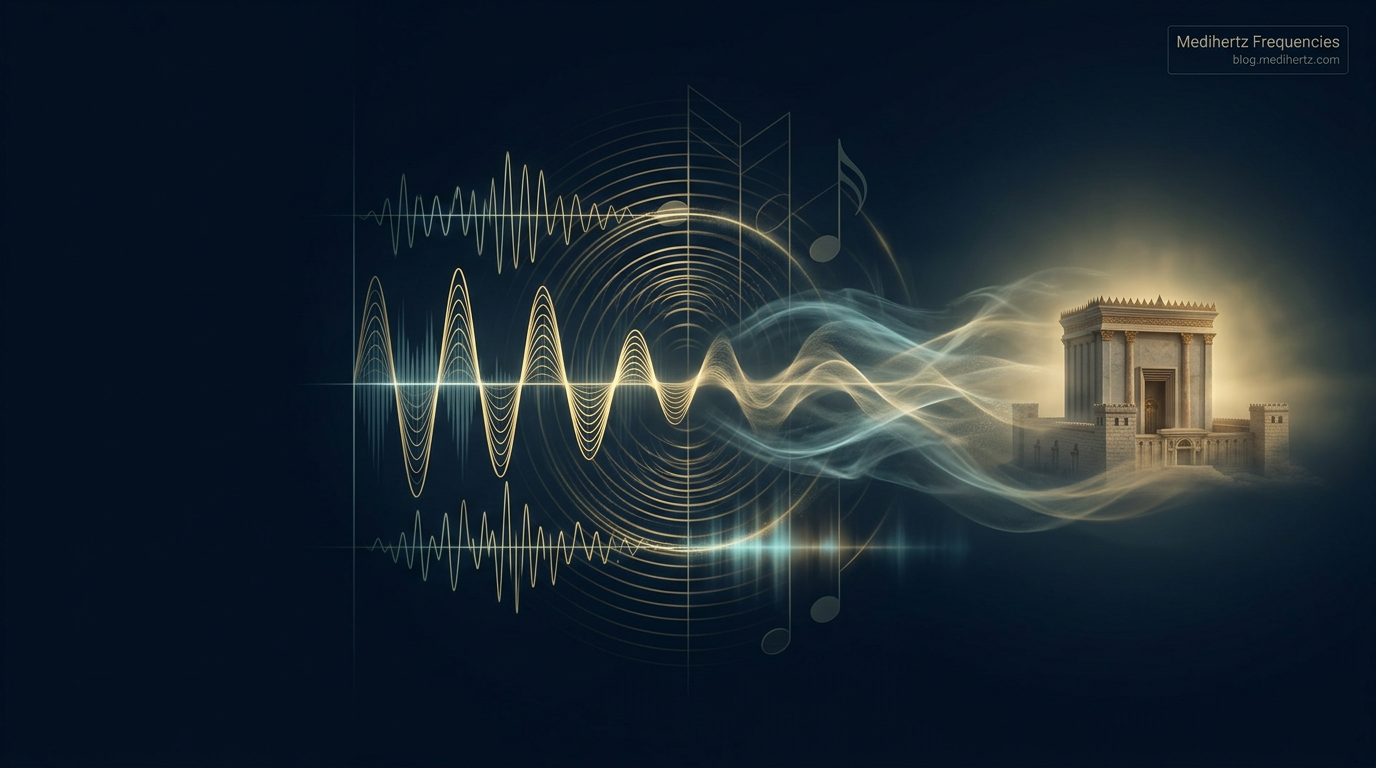
4. What Would the Frequencies of a Sacred Song Look Like?
Let’s connect the ancient world to modern sound science.
Every musical note has a measurable frequency. Using modern standard tuning, the note A4 is commonly set to 440 Hz. Other notes in a modern equal-tempered scale have corresponding frequencies.
For example:
| Musical note | Frequency |
|---|---|
| C4 | 261.63 Hz |
| D4 | 293.66 Hz |
| E4 | 329.63 Hz |
| G4 | 392.00 Hz |
| A4 | 440.00 Hz |
These are modern reference values—not recovered notes from a biblical prayer.
Imagine a singer performing a psalm using these notes. We could measure the sound, identify its fundamental frequency, study its harmonics, and analyze the melody.
But if another singer performed the same prayer at a different pitch, the frequencies would change even though the words remained the same.
This is why there is no single frequency that can be identified as the biblical frequency of a prayer simply because the prayer is sacred.
The prayer’s spiritual meaning comes from its place in Scripture and the faith of the person praying, not from an established secret musical scale.
5. Is 432 Hz or 528 Hz the Frequency of God’s Voice?
You may have encountered claims that 432 Hz is the natural frequency of the universe or that 528 Hz is the frequency of miracles, DNA repair, or divine connection.
These claims are popular in modern wellness and spiritual communities, but they should not be confused with biblical teachings or established scientific conclusions.
The Bible does not identify 432 Hz or 528 Hz as God’s voice, prescribe them for prayer, or promise that they produce miracles.
A 432 Hz tone can be generated and measured. So can a 528 Hz tone. Whether someone finds either tone relaxing or meaningful is a separate question from whether it has a special divine status.
There is no established scientific method for tuning a musical instrument to a frequency that guarantees communication with God.
That does not mean you cannot use gentle music or sustained tones while praying. It simply means that a personal spiritual practice should not be presented as a hidden biblical fact.
6. Could Singing a Prayer Help Us Feel Closer to God?
There is a more grounded way to explore the relationship between prayer and sound.
When you sing or chant a prayer, you combine words, breath, rhythm, repetition, and focused attention. These elements can shape how you experience the moment.
A slow melody may help you settle down. Repeating meaningful words may help you concentrate. Music may evoke memories, comfort, gratitude, or a sense of connection.
The experience varies from person to person, and it does not prove that a particular frequency has activated God’s voice.
Psalm 150 offers a striking biblical example of worship through sound. Its message is not to find one perfect tone, but to praise God through singing, instruments, and the full expression of worship.
For a person of faith, music can be a meaningful companion to prayer without needing to be treated as a supernatural frequency code.
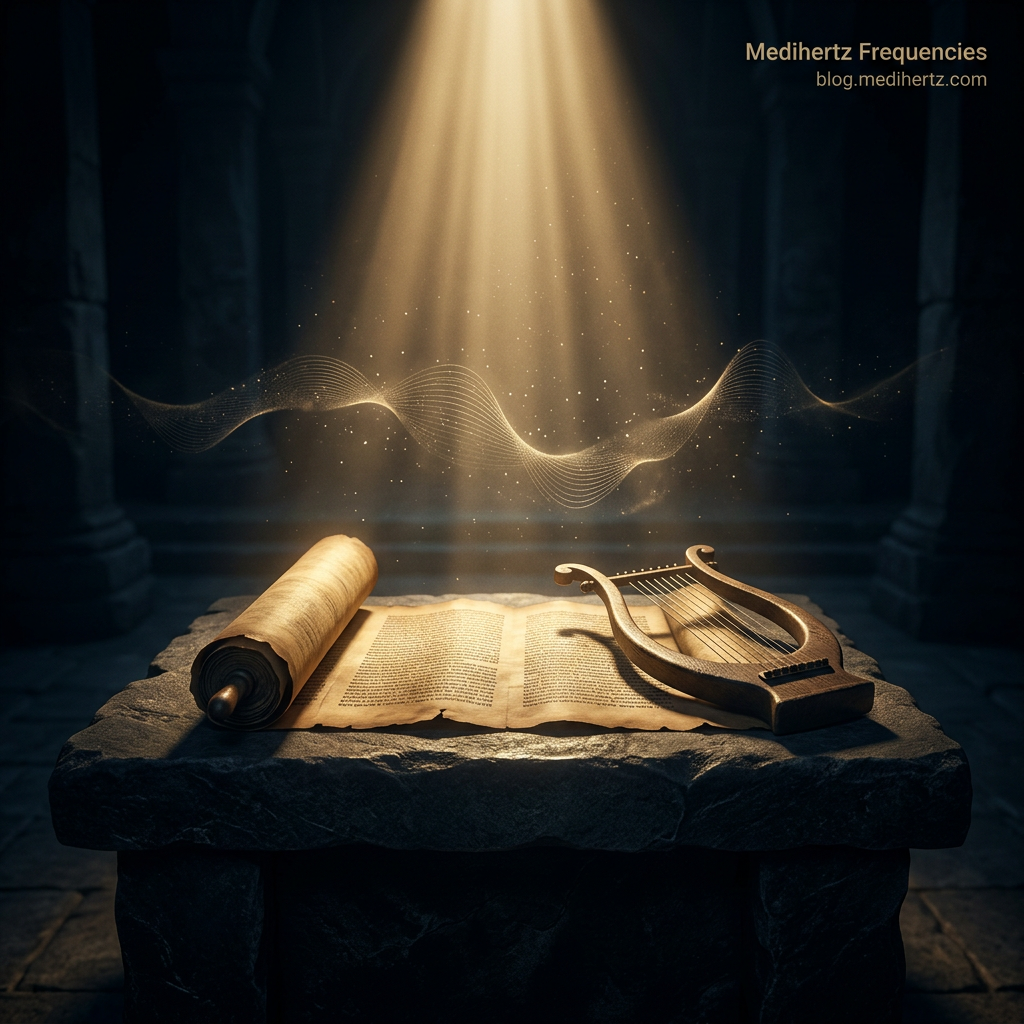
The Final Mystery: What Has the Bible Actually Revealed?
The Bible gives us three fascinating starting points:
- Genesis 1:3: God’s word is central to the biblical account of creation.
- Psalm 29: God’s voice is portrayed through powerful imagery of thunder, waters, and the natural world.
- Psalm 150: Music and instruments become expressions of praise.
Together, these passages invite us to explore sound as a subject of faith, history, music, and human experience.
But they do not reveal a numerical frequency for God’s voice, a confirmed secret scale for ancient prayer, or a special note that guarantees divine contact.
Perhaps the most meaningful discovery is not a hidden number of hertz. It is the difference between the physical sound we can measure and the spiritual meaning people find in the words they sing.
We can measure a tone in hertz. We can study an ancient song. But the Bible does not tell us that measuring a frequency allows us to measure God’s presence.
That is where the mystery of sacred sound remains: in the meeting of music, faith, history, and the human desire to connect with something greater than ourselves.
Frequently Asked Questions
Does God talk about frequencies in the Bible?
Not in the modern scientific sense of frequencies measured in hertz. The Bible discusses God’s voice, music, singing, and creation, but does not provide numerical sound-frequency values.
What is God’s frequency according to the Bible?
The Bible does not specify God’s frequency. Numbers such as 432 Hz and 528 Hz are modern sound-frequency values, not frequencies identified in Scripture.
Which Bible verse talks about God’s voice?
Psalm 29 is one of the clearest examples. It repeatedly describes the voice of the Lord as powerful and majestic, using imagery associated with thunder and nature.
Did biblical prayers use particular musical notes?
Ancient prayers and psalms were sung, but the exact melodies and pitches of many original performances are not known with certainty. No single frequency scale has been established as the universal scale of biblical prayer.
Can I listen to 432 Hz or 528 Hz while praying?
Yes, if you find those tones helpful for personal reflection or relaxation. However, the Bible does not specifically recommend them, and there is no established evidence that they guarantee divine communication or healing.
☸
“`html
“`
