Why Do You Feel Weird After Listening to Binaural Beats? What Happens in Your Brain?
Feeling weird after listening to binaural beats can happen because your brain is processing unfamiliar rhythmic sounds, while factors such as sound sensitivity, listening volume, headphone quality, tiredness and individual differences may influence your experience. Some people feel relaxed or sleepy, while others experience dizziness, restlessness, irritation or no noticeable effect.
Binaural beats work by playing two slightly different sound frequencies, one into each ear. Your brain processes the difference between these tones and creates the perception of a rhythmic beat. Researchers have investigated whether this auditory rhythm can influence brain activity, but scientific evidence that binaural beats reliably control brainwave states remains mixed.
If you feel uncomfortable, dizzy or develop a headache, stop listening, remove your headphones and rest.
But why do different people experience different sensations? What happens inside your brain when you hear these sounds? Can binaural beats influence your memory, concentration, relaxation or sleep?
Let’s explore the science of binaural beats, brainwaves, sound vibrations and the ways you can experiment with different frequencies.
Why Do You Feel Strange After Listening to Binaural Beats?
Your experience with binaural beats can vary depending on your sensitivity to sound, listening environment, attention and physical condition.
Here are five common experiences you might notice.
1. Why Do Binaural Beats Make You Feel Sleepy?
Slow, repetitive sounds in a quiet environment may help you settle down and become less focused on your surroundings.
You may notice that your breathing feels calmer, your body relaxes and you gradually become sleepy.
This can happen during ordinary relaxation too. It does not necessarily mean that a particular brainwave has taken control of your brain.
2. Can Binaural Beats Make You Feel Dizzy?
Some listeners report dizziness or disorientation when listening to binaural beats.
The brain processes two slightly different tones delivered separately to your ears. This creates the perception of a rhythmic auditory beat that may feel unfamiliar to some listeners.
Sound sensitivity, excessive volume, headphone quality and prolonged listening may also contribute to discomfort.
If you experience dizziness, remove your headphones and stop listening. Rest before deciding whether to try again.
3. Why Do You Feel Mentally Alert but Physically Relaxed?
You might feel comfortable sitting quietly while your mind continues thinking, remembering, planning or imagining things.
This is possible because physical relaxation and mental activity are not opposites.
Your brain continues processing information even when your body is resting.
4. Can Binaural Beats Make You Feel Restless or Irritated?
Not everyone enjoys repetitive sounds.
Certain tones, pitches and pulsing patterns may become irritating, especially when played repeatedly.
Your personal sound preferences matter. A frequency that feels relaxing to one listener may be unpleasant to another.
5. Why Do You Feel Nothing When Listening to Binaural Beats?
Some people notice relaxation or a rhythmic sensation, while others experience no obvious difference.
This is completely normal.
Binaural beats do not produce a guaranteed sensation or identical response in everyone.
What Are Binaural Beats and How Do They Work?
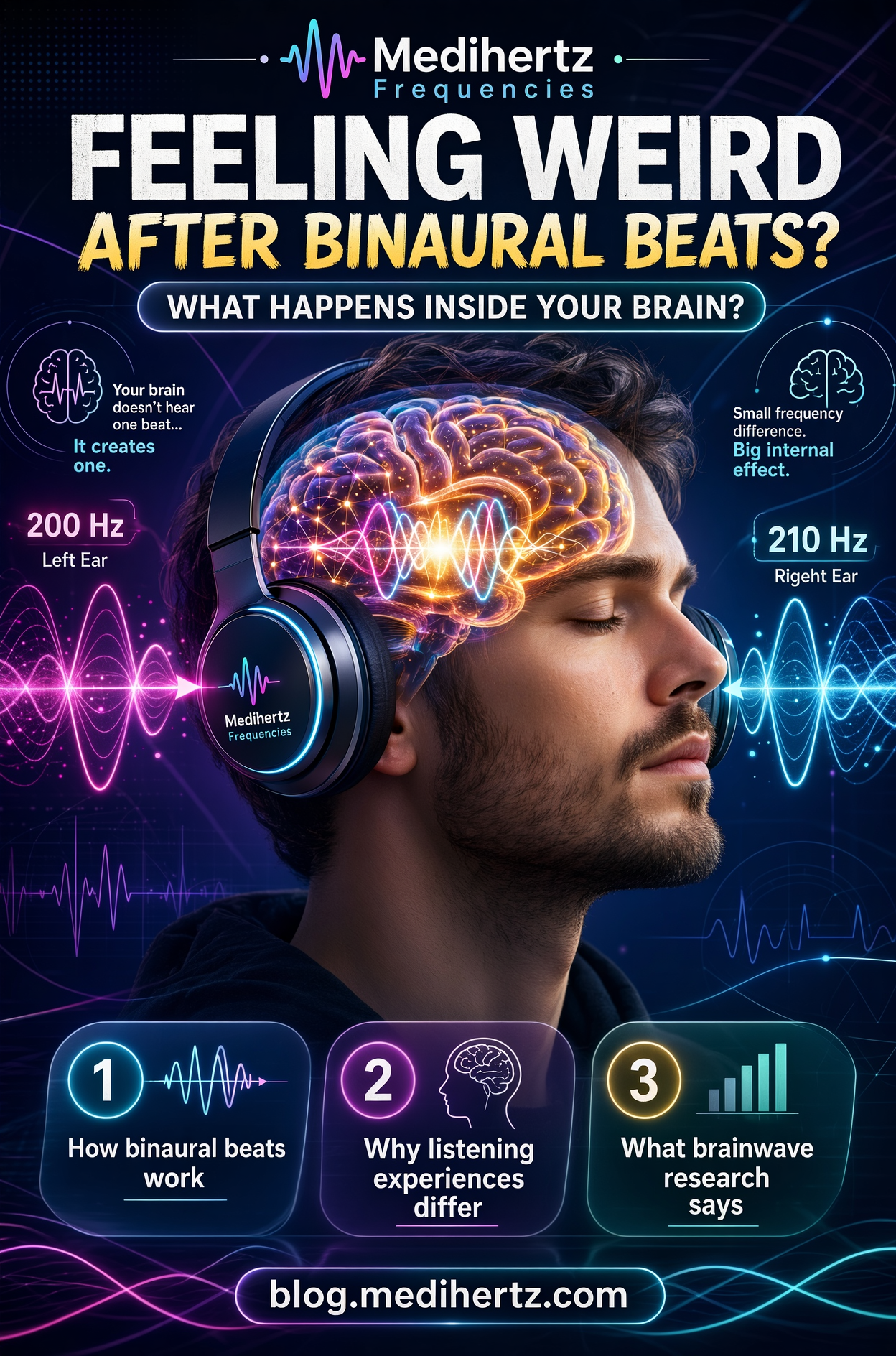
Binaural beats are an auditory illusion created when two slightly different sound frequencies are delivered separately to your ears.
Your brain processes these tones and you perceive a rhythmic beat corresponding approximately to the difference between their frequencies.
For example:
- Left ear: 200 Hz.
- Right ear: 204 Hz.
- Perceived binaural beat: 4 Hz.
The mathematical calculation is:
204 − 200 = 4 Hz
Neither ear receives a separate 4 Hz tone. Instead, your auditory system processes the difference between the two tones.
An important brain structure involved in comparing sound information from your ears is the superior olivary complex, located in the brainstem.
Your auditory system uses information from both ears to process differences in sound timing and other acoustic characteristics.
This is why stereo headphones are important for experiencing the classic binaural beat effect. Each ear needs to receive its own tone.
Do Binaural Beats Actually Change Your Brainwaves?
This is one of the most interesting questions in sound research.
When you listen to a 4 Hz binaural beat, you experience an auditory rhythm. Researchers have investigated whether this rhythm can influence electrical activity in your brain.
This possibility is commonly discussed under the term brainwave entrainment.
Some studies have measured brain responses at or near the binaural beat frequency. However, an auditory response does not necessarily mean that your entire brain has entered a particular brainwave state.
For example, listening to a 4 Hz binaural beat does not guarantee that your brain enters a complete theta state.
Your brain uses many different rhythms and neural networks simultaneously.
A 2023 systematic review examined 14 studies:
- Five supported the brainwave entrainment hypothesis.
- Eight reported contradictory findings.
- One reported mixed findings.
The research therefore remains inconclusive.
Binaural beats are an interesting area of neuroscience, but claims that they can precisely control your brainwaves or guarantee specific mental abilities should be treated cautiously.

What Are Brainwaves and What Do They Do?
Brainwaves are patterns of electrical activity produced by groups of neurons communicating within your brain.
Researchers measure these patterns using a technique called electroencephalography (EEG).
Your brain remains electrically active whether you are sleeping, concentrating, relaxing or having a conversation.
Different patterns of brain activity are commonly grouped into five frequency categories:
- Delta waves
- Theta waves
- Alpha waves
- Beta waves
- Gamma waves
Each category is associated with different brain processes.
1. Delta Waves: Deep Sleep and Rest
Frequency range: Approximately 0.5–4 Hz
Delta activity is commonly associated with deep, non-REM sleep.
During deep sleep, your brain participates in important processes related to memory, learning and normal body recovery.
Sleep is not simply a period when your brain switches off. It remains active and carries out different processes that support everyday functioning.
You can explore slow delta-range binaural beats as optional background audio during a peaceful bedtime routine.
However, listening to delta frequencies does not guarantee deep sleep.
2. Theta Waves: Memory, Imagination and Relaxation
Frequency range: Approximately 4–8 Hz
Theta activity is associated with several processes, including memory, emotional processing and certain stages of drowsiness and sleep.
Your brain needs to receive information, process it, connect it with existing knowledge and retrieve it later.
Theta activity has been studied in relation to memory formation and communication between different brain regions.
Theta-range sounds are also popular during meditation and relaxation.
You can explore gentle theta-range binaural beats alongside breathing exercises, quiet reflection or journaling.
3. Alpha Waves: Calm Awareness
Frequency range: Approximately 8–13 Hz
Alpha activity is commonly associated with relaxed wakefulness.
For example, you might sit quietly with your eyes closed, relax your body and allow your attention to settle.
Alpha activity is also studied in relation to attention and your brain’s ability to manage distracting information.
This makes alpha-range sounds interesting to explore during meditation, quiet breaks and relaxation.
However, alpha activity is not a switch that automatically removes stress or creates happiness.
4. Beta Waves: Thinking, Planning and Concentration
Frequency range: Approximately 13–30 Hz
Beta activity is commonly associated with active thinking and alertness.
You use many of the mental processes associated with beta activity throughout your day:
- Reading and understanding information.
- Planning your activities.
- Solving mathematical problems.
- Having conversations.
- Making decisions.
- Organising information.
Beta activity is not the only brain activity involved in these tasks. Different brain regions and rhythms work together.
Some people experiment with beta-range binaural beats while studying or working. Others find repetitive audio distracting.
Compare your concentration with and without the sound instead of assuming it must improve your performance.
5. Gamma Waves: Processing and Combining Information
Commonly discussed frequency range: 30–100 Hz
Gamma activity is a faster pattern of neural activity studied in relation to attention, perception, memory and the integration of information.
Think about recognising a familiar face.
Your brain processes visual information, compares it with stored memories and connects different pieces of information.
Many brain networks participate in this process.
Gamma activity is one part of a much larger system.
Listening to a 40 Hz binaural beat does not automatically improve your intelligence, memory or cognitive ability.
Brainwave Frequency Chart
| Brainwave | Approximate frequency | Common associations |
|---|---|---|
| Delta | 0.5–4 Hz | Deep sleep |
| Theta | 4–8 Hz | Memory, drowsiness and emotional processing |
| Alpha | 8–13 Hz | Relaxed wakefulness |
| Beta | 13–30 Hz | Active thinking and attention |
| Gamma | Above 30 Hz | Information integration and attention |
These ranges are approximate. Brainwave patterns can overlap, and your brain does not use only one frequency at a time.
How Do Brainwaves Relate to Your Everyday Activities?
Understanding brainwaves becomes easier when you connect them with everyday experiences.
Learning something new: Your brain receives information, connects it with existing knowledge and stores parts of it in memory. Different neural networks and rhythms participate in this process.
Concentrating: Your brain manages attention, processes information and filters distractions.
Relaxing: Your brain continues processing sounds, memories and thoughts even when you are sitting quietly.
Sleeping: Your brain moves through different sleep stages and carries out processes related to memory and normal recovery.
Solving problems: Your brain combines information, retrieves memories, compares possibilities and makes decisions.
These activities involve complex brain networks. They cannot be reduced to one frequency.
This is why claims that a particular binaural beat can activate a specific skill or give you a guaranteed mental ability should be treated cautiously.
What Is Cymatics? Can You See the Effects of Sound?
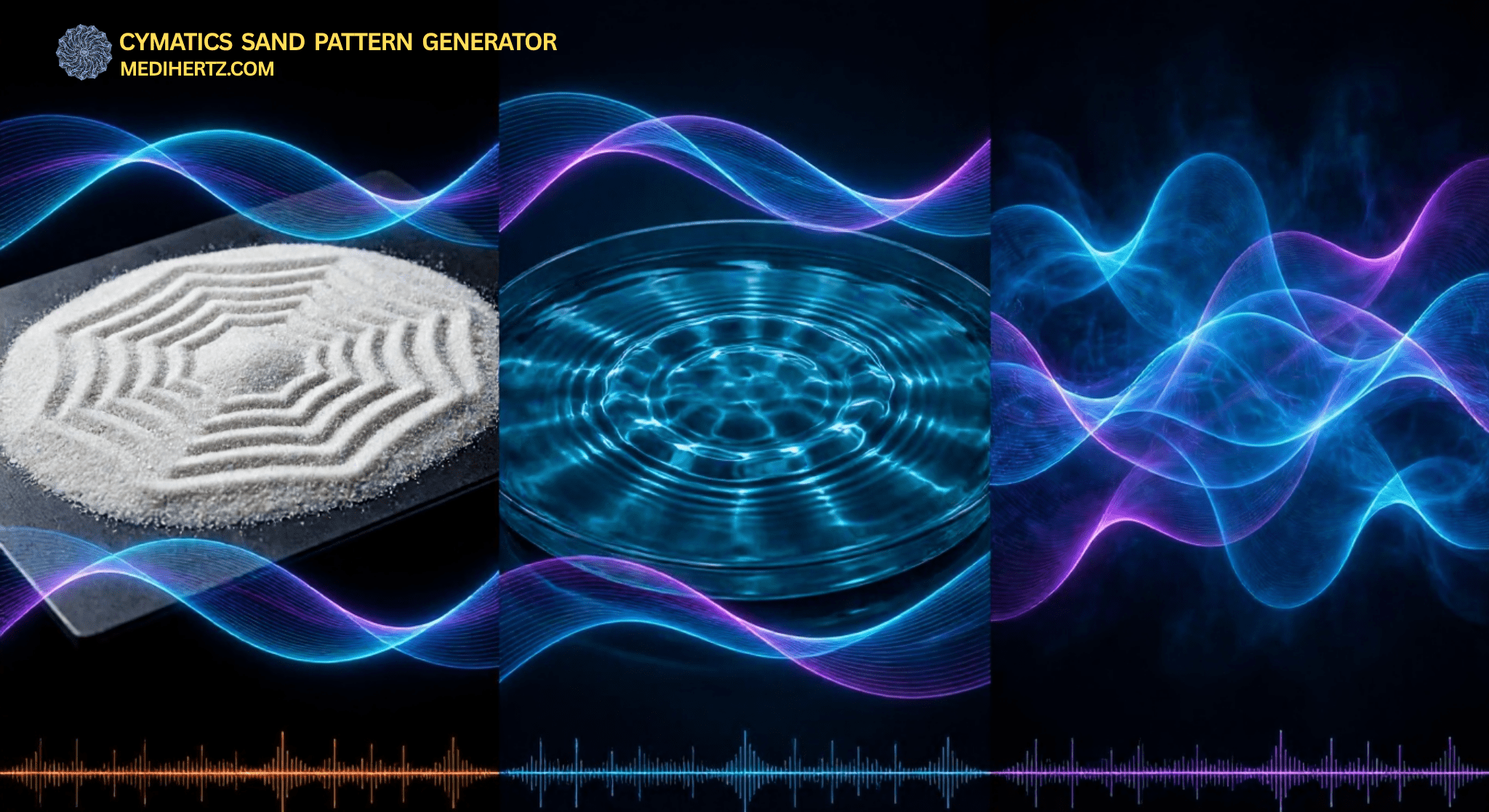
Cymatics is the study of visible patterns created by vibration.
Sound is normally invisible, but its physical effects can sometimes be observed through experiments involving vibrating materials.
One famous example is the Chladni plate experiment.
How Does the Chladni Plate Experiment Work?
In this experiment, a thin metal plate is covered with fine sand or another suitable powder.
The plate is connected to a vibrating source.
When the plate vibrates, different areas move in different ways. Some areas vibrate strongly, while other areas remain relatively still.
The sand moves away from areas of strong vibration and collects along the relatively still regions.
These lines are called nodal lines.
When the vibration frequency changes, the pattern can change too.
The resulting geometric patterns can be fascinating.
The patterns depend on several factors:
- Frequency of vibration.
- Shape and size of the plate.
- Material and thickness.
- How the plate is supported.
- Strength of the vibration.
Cymatics demonstrates how physical materials respond to vibration.
However, a beautiful geometric pattern does not prove that a particular frequency has healing properties.
How Does Sound Travel Through Solids, Liquids and Gases?
Sound is a mechanical wave. It needs a material medium to travel through.
It can travel through solids, liquids and gases, although its speed and behaviour change depending on the material.
Sound in Solids
Think about a metal plate, wooden table or glass object.
When an object vibrates, it transfers that vibration through the material.
If the object is excited at a suitable resonant frequency, its vibration can become more noticeable.
This is why certain objects produce stronger sounds or visible vibration patterns at particular frequencies.
Chladni plate experiments demonstrate this behaviour.
Sound in Liquids
Sound can travel through water because water particles transfer pressure changes.
When a sound source vibrates near or in water, it can create pressure variations and sometimes visible surface movement.
The movement depends on frequency, intensity, container shape and the position of the sound source.
These experiments demonstrate how sound interacts with liquids, but they do not establish that a particular frequency automatically changes the biological properties of water.
Sound in Gases
Air is a gas and the medium through which you normally hear sound.
Sound travels through air as pressure variations, including regions of compression and lower pressure.
A useful physics demonstration is the Kundt’s tube experiment.
Sound creates standing-wave patterns inside a tube. Small particles inside the tube collect in particular areas, making the wave pattern easier to observe.
What Is the Difference Between Cymatics, EEG and Binaural Beats?
These three concepts involve different physical processes.
| Concept | What it demonstrates |
|---|---|
| Cymatics | Visible patterns created by mechanical vibration |
| EEG | Electrical activity measured from the scalp |
| Binaural beats | Auditory perception created by differences between two tones |
Cymatics does not prove that 528 Hz repairs cells, 7.83 Hz balances your brain or a particular frequency heals an organ.
It is still fascinating to explore how sound interacts with the physical world while keeping the scientific explanations accurate.
How Can You Use Binaural Beats for Relaxation, Meditation, Sleep and Focus?
You can explore binaural beats by choosing an activity first and then experimenting with a comfortable sound.
The following are practical listening ideas, not medical treatments or scientifically proven frequency prescriptions.
1. Binaural Beats for Relaxation
Suggested beat difference to explore: 8–10 Hz (Alpha range)
- Find a quiet and comfortable place.
- Use stereo headphones.
- Choose a gentle alpha-range binaural beat.
- Keep the volume low.
- Relax your shoulders and allow your breathing to settle.
- Start with 5–10 minutes.
You can use this as a short break after a busy day.
Allow the sound to play while you relax without forcing yourself to stop thinking.
2. Binaural Beats for Meditation
Suggested beat difference to explore: 4–7 Hz (Theta range)
- Sit comfortably with your back supported.
- Choose a gentle theta-range binaural beat.
- Close your eyes if that feels comfortable.
- Pay attention to your natural breathing.
- When thoughts appear, gently return your attention to your breath.
- Start with a short session.
The important part of this practice is not just the sound. It is also the attention and breathing exercise.
3. Binaural Beats for Sleep Preparation
Suggested beat difference to explore: 1–3 Hz (Delta range)
- Choose a gentle delta-range sound.
- Listen while preparing for bedtime.
- Keep the volume very low.
- Use a timer rather than playing audio loudly throughout the night.
- Follow a regular sleep routine.
You can use binaural beats as an optional part of a relaxing bedtime environment.
They are not a replacement for healthy sleep habits or treatment for sleep disorders.
4. Binaural Beats for Reading and Concentration
Suggested beat difference to explore: 14–18 Hz (Beta range)
- Choose a gentle beta-range binaural beat.
- Start a simple reading or desk-work task.
- Keep the sound low enough that it does not compete with the task.
- Work for a short period.
- Compare your concentration with and without the audio.
Some people enjoy background sound while working. Others concentrate better in silence.
Choose whichever environment helps you complete the task comfortably.
5. Binaural Beats for Creative Thinking
Suggested beat difference to explore: 8–10 Hz (Alpha range)
- Choose a comfortable alpha-range sound.
- Listen for a few minutes before starting creative work.
- Think about the topic you want to explore.
- Turn off the audio.
- Start brainstorming, drawing or writing.
You can use this as a creative warm-up.
The sound does not guarantee new ideas, but a quiet listening routine may help you create a comfortable environment for thinking.
6. Explore Different Binaural Beat Frequencies
You can experiment with different beat frequencies and compare how each listening experience feels.
| Left ear | Right ear | Binaural beat difference |
|---|---|---|
| 200 Hz | 201 Hz | 1 Hz |
| 200 Hz | 204 Hz | 4 Hz |
| 200 Hz | 208 Hz | 8 Hz |
| 200 Hz | 215 Hz | 15 Hz |
| 200 Hz | 240 Hz | 40 Hz |
The difference between the two tones determines the perceived binaural beat frequency.
The carrier tones themselves are not the brainwave frequencies.
For example, 200 Hz and 204 Hz create a perceived 4 Hz binaural beat. You are not receiving a separate 4 Hz tone in either ear.
How Can You Listen to Binaural Beats Safely and Comfortably?
A few simple habits can make your listening experience more comfortable.
1. Use stereo headphones: Each ear needs to receive a different tone for the classic binaural beat effect.
2. Keep the volume comfortable: Increasing volume does not guarantee stronger brainwave effects. Protecting your hearing is more important.
3. Start with short sessions: Begin with 5–10 minutes and see how you respond.
4. Choose one activity: Decide whether you want to relax, meditate, prepare for sleep or work before choosing the sound.
5. Avoid constantly changing frequencies: Explore one comfortable setting at a time rather than changing the beat every few seconds.
6. Pay attention to your response: If you feel uncomfortable, dizzy, irritated or develop a headache, stop listening.
7. Compare the experience with silence: Sometimes a quiet room is more comfortable than audio.
8. Avoid listening during activities that require full attention: Do not experiment with binaural beats while driving, operating machinery or doing anything where distraction could be dangerous.
If you have epilepsy, a history of seizures or other relevant neurological concerns, consult a healthcare professional before experimenting with brainwave-stimulation audio.
Explore Binaural Beats and Sound Frequencies With Medihertz Tools
Understanding binaural beats becomes more interesting when you can experiment with different sounds instead of only reading about them.
Medihertz provides frequency and sound-based tools that let you explore individual tones, binaural beats and different listening experiences.
Binaural Beats Generator
The Medihertz Binaural Beats Generator lets you explore the difference between two tones.
You can experiment with:
- Left-ear frequency.
- Right-ear frequency.
- Difference between the two tones.
- Different carrier tones.
- Comfortable sound levels.
Start with a small difference between the two tones and explore how the resulting sound feels.
Explore the Medihertz Tools Hub.
Instant Hz Listener
The Medihertz Instant Hz Listener allows you to explore individual sound frequencies.
You can use it to understand the difference between listening to an individual tone and listening to a binaural beat.
For example, 528 Hz is an individual sound frequency, whereas a 4 Hz binaural beat is the perceived difference between two tones delivered separately to your ears.
Solfeggio Frequency Generator
Solfeggio frequencies are commonly explored in meditation and sound-based wellness experiences.
Some frequently discussed examples include:
- 174 Hz
- 396 Hz
- 417 Hz
- 528 Hz
- 639 Hz
- 741 Hz
- 852 Hz
- 963 Hz
You can explore these tones as part of your personal sound and meditation routine.
However, claims that these frequencies cure diseases or repair specific organs are not established medical facts.
Other Medihertz Sound Experiences
You can also explore other sound-based tools for different activities:
- Nox Nidra: A relaxation and sleep-preparation experience.
- Om for Focus: An Om-based listening experience.
- Room Energy Reset: A sound-based environment experience.
- Anger Management: A sound-based relaxation break.
Each tool offers a different way to explore sound and your personal listening preferences.
Frequently Asked Questions About Binaural Beats
Why Do You Feel Weird After Listening to Binaural Beats?
You may feel sleepy, relaxed, dizzy, restless or uncomfortable. Possible factors include unfamiliar rhythmic sounds, attention, tiredness, sound sensitivity and listening conditions. There is no single explanation for everyone.
Can Binaural Beats Cause Dizziness or Headaches?
Some people report dizziness or discomfort while listening. The causes are not well established. Stop listening if this happens, remove your headphones and rest. Seek medical advice if symptoms persist or are severe.
Can Binaural Beats Change Your Brainwaves?
Research has investigated whether binaural beats can influence brain activity. Some studies report changes in neural responses, but evidence that they reliably entrain your brain into a particular frequency state remains inconsistent.
Can You Listen to Binaural Beats Every Day?
There is no universally established daily listening schedule. You can experiment with short, comfortable sessions at a safe volume and stop if you experience unwanted effects.
Can You Listen to Binaural Beats Without Headphones?
Ordinary audio can be played through speakers, but the classic binaural beat effect requires different tones to reach your two ears separately. Stereo headphones are the usual way to achieve this.
What Is the Difference Between Binaural Beats and Solfeggio Frequencies?
Binaural beats are created by delivering two different tones separately to your ears, producing a perceived rhythmic difference.
Solfeggio frequencies refer to individual sound frequencies commonly used in meditation and wellness audio. They are different concepts.
Which Binaural Beat Is Best for Sleep?
Some people experiment with delta-range binaural beats for sleep preparation. However, there is no universally proven best frequency for sleep, and binaural beats should not replace healthy sleep habits or medical care.
Why Do You Feel Nothing When Listening to Binaural Beats?
People respond differently to sound. You might notice a rhythmic sensation or relaxation, while someone else notices very little. Feeling nothing unusual does not mean something is wrong.
Can Binaural Beats Improve Memory and Concentration?
Binaural beats are being researched for possible effects on attention, memory and other mental processes. The evidence is not strong enough to promise consistent improvements. Sleep, practice, a suitable working environment and healthy habits remain important for memory and concentration.
What Is the Difference Between Binaural Beats and Ordinary Sound Frequencies?
An ordinary sound frequency, such as 528 Hz, describes the frequency of an individual tone.
A binaural beat is the perceived rhythmic difference between two slightly different tones delivered separately to your ears.
For example, 200 Hz in your left ear and 204 Hz in your right ear create a perceived 4 Hz binaural beat.
Final Thoughts: Understand Your Brain Before Choosing a Frequency
When you explore binaural beats, you do not need to chase a particular frequency or expect an extraordinary experience.
Start with a comfortable sound, listen for a few minutes and notice how you feel.
Some days, you might enjoy a gentle alpha-range sound while working. On other days, you may prefer theta-range audio during meditation. Sometimes, a peaceful environment without any audio may be exactly what you need.
Your brain is a complex system. It uses many rhythms, networks and processes together. A binaural beat is an interesting way to explore sound and attention, but it is not a switch that controls your entire brain.
The best listening experience is one that feels comfortable, supports the activity you have chosen and fits naturally into your day.
References and Further Reading
- Systematic Review of Binaural Beats and Brainwave Entrainment (2023)
- Cedars-Sinai: Sound Therapy and Binaural Beats — Do They Work?
- Google Scholar: Binaural Beats and Auditory Brain Responses
- Google Scholar: Brainwaves, EEG and Cognitive Processes
- Google Scholar: Chladni Plates and Cymatics
This article is for educational purposes. Binaural beats are not a medical treatment and should not replace professional medical advice.
☸