Best Sound Healing Frequencies for Meditation (Complete Guide)
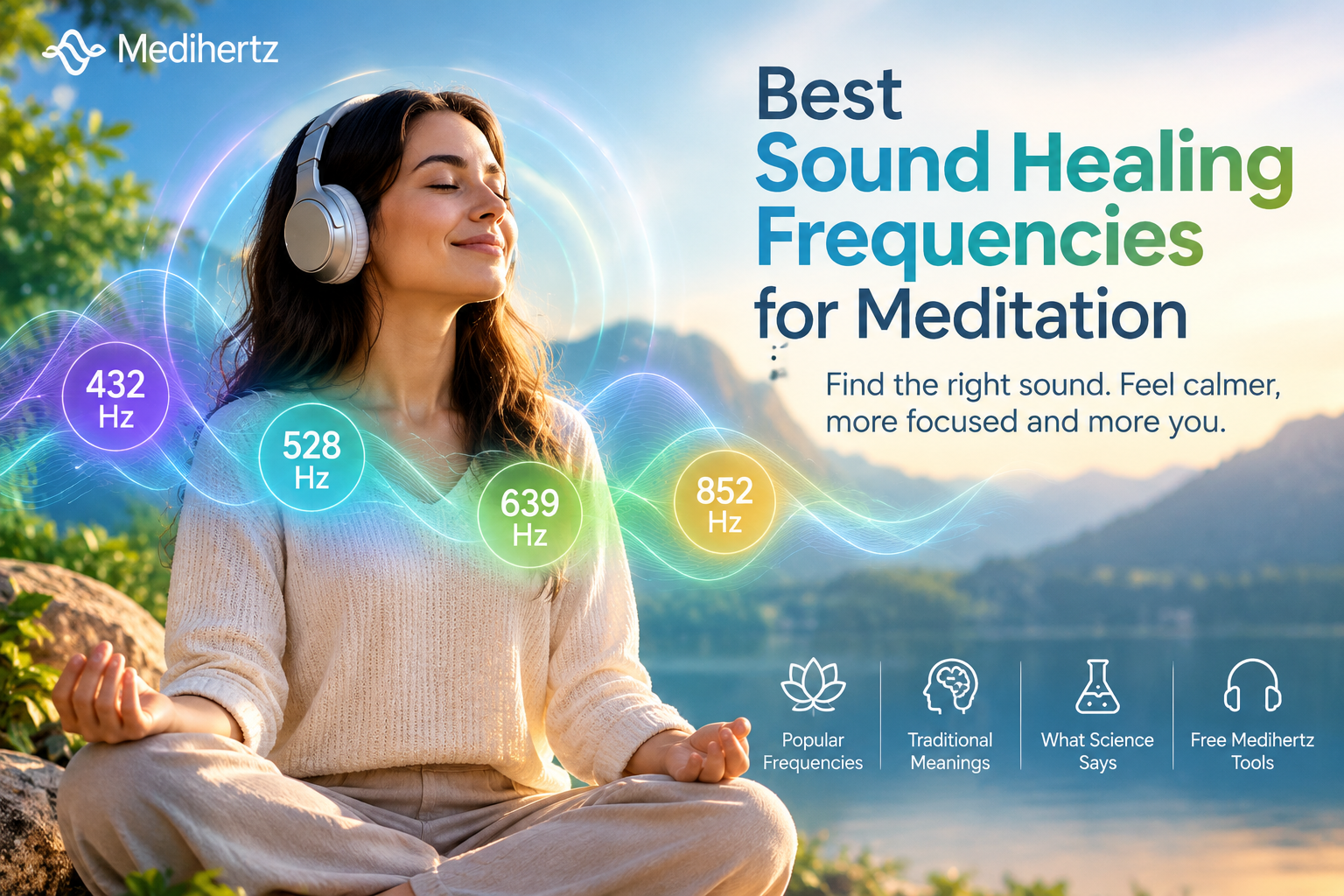
Healing frequencies for meditation are sounds at specific pitches, such as 432 Hz and 528 Hz, that people explore for relaxation, mindfulness, and inner peace. But which frequency should you choose? Discover the most popular healing frequencies, their traditional meanings, what science actually says, and how to explore them with free Medihertz sound tools to create a peaceful listening experience that feels right for you.
Why do you should use Sound to meditate?
Have you ever felt tired… not just physically, but mentally and emotionally too?
In today’s fast, busy, and often emotionless world, our minds are constantly overloaded — notifications, stress, pressure, overthinking. We rarely get a moment of true silence.

That’s where sound frequencies and meditation come in.
Our mind is constantly under the influence of Sound. Sound is attached to visuals when we watch a video, and it surrounds us when we walk, talk, or carry out our daily activities. Even while sleeping, we hear sounds that we may not remember, but we can still become alert when something needs our attention.
This explains how, even when we do not consciously notice a sound, a part of our brain continues to keep track of the sounds around us and filters important sounds into our conscious mind.
In this scenario, we can understand how we could use sound to guide our brain. Playing the right resonating frequency for your brain, can act just like giving a gentle stretch to your aching back, helping you feel relaxed. In this way, we can replace the noise with the signal, at least for a few minutes in a day.
Your brain will thank you for it.
But the big question is:
What Are the Best Healing Frequencies for Meditation?
Where should i begin?
Healing frequencies are sounds played at specific frequencies that people explore for meditation, relaxation, mindfulness, and personal wellness. Popular choices include 432 Hz, 528 Hz, and Solfeggio frequencies such as 396 Hz, 417 Hz, 639 Hz, and 852 Hz. Each has its own history, cultural associations, and listening experience.
The best sound frequency for meditation depends on your personal preference and the experience you want to create. Some people prefer a gentle, steady tone, while others enjoy ambient music, singing bowls, nature sounds, or binaural beats. You can explore different sounds, breathe comfortably, and choose the listening experience that helps you feel present and settled.
Explore the Medihertz Hz Frequency Generator to listen to different tones, or visit the Solfeggio Frequency Hub to discover a wider range of traditional meditation frequencies.
It is helpful to understand that a sound’s frequency can be measured precisely, but claims that a particular number automatically heals the body, repairs DNA, or treats a medical condition have not been established by strong scientific evidence. Sound can be a meaningful part of a personal wellness routine without needing to promise a medical result.
Popular Sound Healing Frequencies and Their Traditional Uses
Different sound frequencies are used in meditation, sound baths, spiritual practices, and personal relaxation routines. The following table separates popular traditional associations from what a listener can reasonably expect.
| Frequency or sound | Common association | How to explore it |
|---|---|---|
| 174 Hz | Often associated with comfort and grounding in modern Solfeggio wellness traditions | Try a gentle tone at a comfortable volume during quiet breathing |
| 396 Hz | Traditionally associated with releasing fear or guilt in Solfeggio-based practices | Use it as a focus for reflection or a personal meditation ritual |
| 417 Hz | Often associated with change and fresh beginnings in modern Solfeggio traditions | Pair it with a short intention-setting session |
| 432 Hz | Popular in relaxation music and meditation playlists | Compare it with other tuning choices and notice which sound you prefer |
| 528 Hz | Commonly associated with transformation and positive change in modern wellness traditions | Explore it as a meditation tone without expecting a guaranteed healing effect |
| 639 Hz | Traditionally associated with relationships and connection in Solfeggio-based practices | Use it during a reflection on kindness, gratitude, or connection |
| 852 Hz | Often associated with intuition and spiritual awareness in modern Solfeggio traditions | Include it in a quiet mindfulness or reflective listening session |
| Binaural beats | Used in audio designed around a perceived rhythmic beat | Use stereo headphones and choose an audio track suited to your listening goal |
| Nature sounds and ambient music | Used to create a comfortable and immersive listening environment | Choose sounds you find pleasant and easy to listen to |
Important: These associations describe how frequencies are commonly presented in wellness and spiritual traditions. They are not proof that each frequency produces a specific psychological, physical, or medical effect. Research into sound-based practices varies by method, and individual listening experiences differ.
What Frequency is Best for Meditation?
Let me answer this simply.
👉 There is no single “perfect” frequency for everyone.
Different frequencies affect your brain and emotions in different ways.
However, the most commonly used and effective frequencies are:
- 432 Hz → deep calm and balance
- 528 Hz → healing and emotional release
- 396 Hz → removes fear and stress
- 639 Hz → improves relationships and emotional connection
- 741 Hz → mental clarity and focus
- 852 Hz → spiritual awareness
👉 If you’re a beginner, start with 432 Hz or 528 Hz.
They are the easiest for your mind to accept.
How Do Meditation Frequencies Actually Work?

Let’s understand this in a very simple way.
Your brain is always working on electrical signals.
These signals create brainwaves.
For example:
- Fast brainwaves → stress, anxiety, overthinking
- Slow brainwaves → calm, relaxation, meditation
Now here’s the important part:
👉 Your brain can sync with external sound frequencies.
This is called brainwave entrainment.
When you listen to a steady sound:
- Your brain slowly starts matching that rhythm
- Your thoughts slow down
- Your body relaxes
It’s like your mind is being gently guided into a peaceful state.
What Happens in Your Brain During Meditation?

When you listen to calming frequencies regularly:
- Your stress hormones reduce
- Your heart rate slows down
- Your breathing becomes deeper
- Your mind becomes quieter
And something deeper happens…
👉 Your brain shifts into alpha and theta states
These states are:
- Relaxed
- Creative
- Emotionally open
This is where real healing begins.
🌊 See Sound in Action (Try This Yourself)

Before you just believe all this… let me show you something interesting.
Sound is not just something you hear — it actually moves matter.
When a frequency plays:
- Sand forms patterns
- Water creates waves
- Even air vibrates in specific shapes
👉 This is called cymatics — the science of visible sound.
And here’s something important to think about:
Your body is made of:
- Solids (bones, tissues)
- Liquids (blood, cells)
- Gases (breath, oxygen flow)
👉 So when sound can affect sand and water…
What do you think it’s doing inside your body?
You don’t have to imagine it.
👉 Try it yourself using our Cymatics Sand Pattern Generator
Watch how different frequencies create different patterns.
It will give you a completely new understanding of how sound works.
Once you see it…
Meditation with sound will make much more sense. Before you read this article further, I recomend you to visit this tool and come back again, you won’t get similar kind of tool for now on internet. We have tried our best to create this tool, though it has some flaws, but we keep upgrading time to time. If you liked our efforts you can suport us by watching ads on our websites, or if you want to join our initiatives, you can even mail us for Suport donations on medihertz01@gmail.com.
👉 Cymatics Sand Pattern Generator
What If You Stay in This State for a Long Time?

I hope you have checked how the sound impacts solid, liquid and gas, now it will help you to understand the affects of frequencies on our brain more deeply.
This is where things become powerful.
If you regularly meditate with the right frequencies:
- Your stress response becomes weaker
- Your mind stops reacting instantly to negativity
- You become more emotionally stable
- Your focus improves naturally
Over time, your brain starts learning:
👉 “This calm state is normal.”
And slowly, this becomes your default state.
How Frequencies Affect the Subconscious Mind

Your subconscious mind is always active, even when you are not thinking.
It controls:
- Habits
- Emotions
- Reactions
- Beliefs
When you listen to frequencies in a relaxed state:
👉 Your conscious mind becomes quiet
👉 Your subconscious becomes more open
This means:
- Negative patterns can weaken
- Positive thoughts can go deeper
For example:
- Listening to calm frequencies regularly can reduce anxiety patterns
- Healing frequencies can help release emotional blocks
This is why many people feel:
👉 “Something changed inside me… but I don’t know how.”
Best Frequencies for Different Meditation Goals

Let’s make it simple for you.
🧘 For Deep Meditation
- 432 Hz
- 741 Hz
👉 Helps your mind go quiet faster.
😌 For Relaxation & Stress Relief
- 396 Hz
- 432 Hz
👉 Best after a long, stressful day.
😟 For Anxiety Relief
- 396 Hz
- 528 Hz
👉 Helps release fear and emotional tension.
🎯 For Focus & Clarity
- 741 Hz
- 852 Hz
👉 Good for studying, work, and mental clarity.
💚 For Emotional Healing
- 528 Hz
- 639 Hz
👉 Helps you feel more connected and balanced.
Binaural Beats vs Solfeggio Frequencies

You may have seen these terms.
Let me simplify:
🎧 Binaural Beats
- Two slightly different sounds in each ear
- Brain creates a third frequency internally
👉 Best for deep brain control and focus (Guide)
🎵 Solfeggio Frequencies
- Natural healing tones (like 528 Hz, 432 Hz)
👉 Best for emotional and spiritual healing
🌍 Schumann Resonance Generator
- Resonate with the frequency of Earth
- An online tool, easy to understand
👉 Best for Aligning with yourself Naturally (Guide)
👉 You can use them.
There is no “better” — just what works for you.
Sound Frequencies vs. Brainwaves: What Is the Difference?
Sound frequencies and brainwaves are two different things. Understanding the difference makes it easier to choose meditation audio that suits your preferences.
Sound frequency describes how many times a sound wave vibrates per second. It is measured in hertz (Hz). For example, a 432 Hz tone vibrates 432 times per second. The number describes the sound itself, not a guaranteed effect on the body.
Brainwave frequency describes rhythmic electrical activity measured in the brain, usually with equipment such as an electroencephalogram (EEG). Brain activity is commonly discussed in ranges such as delta, theta, alpha, beta, and gamma. These ranges are associated with different patterns of brain activity, but they are not simple switches for controlling a person’s mental state.
Binaural beats are an auditory effect created when slightly different tones are presented separately to the two ears. The perceived beat corresponds to the difference between the two tones. For example, tones of 200 Hz and 210 Hz can create a perceived 10 Hz binaural beat when delivered appropriately through stereo headphones.
A 10 Hz binaural beat is not the same thing as playing a single 10 Hz audible tone. Likewise, listening to a 40 Hz sound does not automatically mean that the brain has entered a particular gamma state.
Research continues to investigate whether binaural beats can influence attention, relaxation, or stress-related outcomes. Results are mixed, and there is no single frequency or listening method proven to work for everyone.
Simple takeaway: Choose sound frequencies for the listening experience you enjoy, and treat brainwave-based audio as an option to explore rather than a guaranteed way to control your brain activity.
How to Use Frequencies for Meditation (Very Simple)

You don’t need anything complicated.
Just follow this:
- Sit or lie down comfortably
- Use headphones (recommended)
- Play a frequency sound
- Close your eyes
- Focus on your breath
- Let your thoughts come and go
👉 Do this for 10–20 minutes daily
That’s enough.
After few sessions you can notice and upgrade as follows.
Create a peaceful listening space and give yourself a few minutes to enjoy the experience. You do not need special equipment or a complicated routine to begin.
Step 1: Choose a sound you enjoy
Start with a tone such as 432 Hz or 528 Hz, a traditional Solfeggio frequency, gentle instrumental music, or nature sounds. These are options to explore, not a ranking of scientifically proven healing effects.
Step 2: Set a comfortable volume
Keep the audio low enough to remain comfortable. You should be able to stop listening easily, and you should not experience ringing, discomfort, or pain. Headphones are useful for binaural beats, but they are not required for ordinary tones or ambient music.
Step 3: Settle into a comfortable position
Sit in a chair, rest on a cushion, or choose another comfortable position. Let your shoulders relax and breathe naturally. There is no need to force your breathing or concentrate perfectly.
Step 4: Listen and notice your experience
Begin with five to ten minutes if that feels comfortable. Notice the tone, your breathing, and your surroundings. If the sound feels distracting, try a different tone, use softer music, or enjoy a few moments of silence instead.
Step 5: Finish with a simple intention
When you are ready, pause the audio and take a moment to notice how you feel. You might choose an intention such as “I am making space for calm,” “I welcome a fresh start,” or “I will move through my day with patience.”
Step 6: Find your personal preference
Try different sounds on separate occasions. You may prefer a pure tone one day and soft instrumental music the next. Your comfort and enjoyment matter more than following a fixed frequency chart.
Explore the Medihertz Hz Frequency Generator to experiment with tones and create your own listening routine.
Are Healing Frequencies Scientifically Proven to Heal the Body?
Sound is a measurable physical phenomenon, and researchers study how music, sound, and auditory stimulation may influence human experiences such as relaxation, attention, mood, and sleep. However, the evidence depends on the type of sound, the method used, the people studied, and the outcome being measured.
Popular wellness traditions associate particular frequencies with ideas such as emotional balance, spiritual awareness, or transformation. These associations can be meaningful as personal or cultural practices, but they should not be confused with established medical effects.
For example, 528 Hz is widely discussed in modern wellness content, but claims that simply listening to this frequency repairs DNA or guarantees physical healing are not established by strong clinical evidence. Similarly, a binaural beat designed around a particular brainwave range does not guarantee that a listener will enter that mental state.
A systematic review of binaural beats for non-clinical stress management found positive results in some studies, while others showed no clear benefit. The authors also highlighted differences in study methods and the need for stronger research. This means binaural beats may be worth exploring as a personal relaxation practice, but they should not be presented as a proven treatment.
For a balanced overview, read the systematic review of binaural beats and stress management.
A thoughtful approach: Enjoy sound as part of meditation, reflection, or a relaxing daily routine. Choose comfortable audio, notice your own experience, and seek qualified medical advice for health concerns rather than relying on a specific frequency as a treatment.
Try These Frequencies Now 🎧
The best way to understand this is not by reading…
👉 It’s by experiencing it.
Try different frequencies and notice:
- How your body feels
- How your thoughts change
- Which frequency suits you
Stay with the one that feels natural.
Why Meditation is Important Today

Let’s talk honestly.
We live in a world where:
- People are always busy
- Emotions are often ignored
- Stress is normal
- Silence feels uncomfortable
But this is not natural.
Your mind needs:
- Rest
- Stillness
- Emotional release
Meditation gives you that space.
And frequencies make it easier.
Final Thoughts
You don’t need to overthink this.
Start simple.
👉 Pick one frequency
👉 Sit quietly
👉 Listen
👉 Breathe
That’s it.
Over time, you will notice:
- More calm
- Less stress
- Better focus
- Deeper understanding of yourself
And maybe…
for the first time in a long time…
👉 You’ll feel truly at peace.
🎧 Try These Frequencies Instantly – Don’t Just Read, Experience It
You don’t need to imagine how these frequencies feel — you can experience them right now.
👉 Use our Hz Frequency Generator to test every frequency listed below in real-time.
Feel how each Hz shifts your mood, focus, and inner state within seconds.
✨ Want something even simpler?
Use our OM Meditation Tool — a powerful single-frequency experience designed to:
- Instantly reduce stress
- Calm your mind
- Help you chant OM with perfect timing
✨ Short on time?
No problem use our 2 minutes meditation tool, Sthir. It gives you an option of Instant meditation . Though meditation needs time to show its affects , but if you are a biginner or short on time this tool wil help you to calm instantly, you can use it in office, tea breakes, Calm In 2 Minutes, 👉 Sthir
🚀 Ready to go deeper?
Explore our full collection of interactive frequency tools inside the Medihertz Tools Hub — trusted and used by people worldwide for meditation, healing, focus, and inner growth.
👉 Start now. Don’t just read frequencies — feel them.
🌌 Advanced Meditation Frequencies (Quick Reference Table)
Here’s a simple table so you can quickly choose the right frequency based on your need.
| Frequency | What It Does | Brain Effect | Best For | Note |
|---|---|---|---|---|
| 50 Hz | Grounding, connects you to body | Slows overthinking, increases physical awareness | Beginners, anxiety, grounding | Very low frequency, calming |
| 111 Hz | Deep trance, ancient resonance | Moves brain to theta state (deep meditation) | Deep meditation, inner silence | Very powerful for stillness |
| 222 Hz | Balance and harmony | Stabilizes thoughts and emotions | Daily meditation, emotional balance | Easy and safe to use |
| 333 Hz | Expands awareness | Improves clarity and observation | Mindfulness, awareness practices | Good for beginners exploring deeper |
| 444 Hz | Stability and protection feeling | Reduces fear response | Anxiety, emotional strength | Feels safe and grounding |
| 555 Hz | Transformation and change | Activates new thinking patterns | Breaking habits, personal growth | Good during life changes |
| 666 Hz | Deep subconscious activation | Brings hidden thoughts to surface | Shadow work, self-reflection | Use carefully, short sessions |
| 777 Hz | Spiritual connection and insight | Enhances intuition and calm thinking | Spiritual meditation | Deep but gentle |
| 888 Hz | Energy flow and openness | Encourages positive thinking | Manifestation, motivation | Uplifting frequency |
| 999 Hz | Completion and emotional release | Calms emotional overload | Healing, letting go | Good for closure |
🌊 Complete Frequency Guide (1 Hz – 2000 Hz)
| Frequency | Main Effect | Brain / Mind Impact | Best Use | Possible Negative Effect |
|---|---|---|---|---|
| 1 Hz | Deep unconscious state | Delta brainwave (deep sleep) | Sleep, deep healing | Too slow → drowsiness |
| 2 Hz | Deep relaxation | Slows brain activity | Trauma healing | Mental dullness if overused |
| 4 Hz | Deep meditation | Theta state | Subconscious work | Emotional sensitivity |
| 6 Hz | Dream-like state | Theta-alpha mix | Creativity, visualization | Distraction |
| 8 Hz | Calm awareness | Alpha state | Relaxation, light meditation | Mild laziness |
| 10 Hz | Focus + calm | Alpha peak | Study, memory | Overthinking if long use |
| 12 Hz | Alert relaxation | Alpha-beta bridge | Learning, focus | Mental fatigue |
| 14 Hz | Active thinking | Beta start | Productivity | Stress if prolonged |
| 20 Hz | High alertness | Beta state | Problem solving | Anxiety |
| 30 Hz | Fast thinking | High beta | Work, logic | Restlessness |
| 40 Hz | Gamma activation | High cognition | Memory, brain sync | Mental overload |
| 50 Hz | Grounding | Body awareness | Stability, presence | Heavy feeling |
| 60 Hz | Physical awareness | Nervous system alert | Energy boost | Irritation |
| 70 Hz | Sensory activation | Sharp perception | Awareness training | Overstimulation |
| 90 Hz | Neural stimulation | Active mind | Focus | Fatigue |
| 100 Hz | Balance | Stable thinking | General use | Neutral |
| 110 Hz | Ancient resonance | Deep calm | Meditation | Slight heaviness |
| 111 Hz | Trance state | Theta activation | Deep meditation | Disconnection |
| 120 Hz | Calm focus | Balanced state | Study + meditation | Mild dullness |
| 136.1 Hz | Earth frequency (Om) | Natural harmony | Meditation | Minimal |
| 174 Hz | Pain relief tone | Relaxing effect | Body healing | Sleepiness |
| 200 Hz | Stability | Balanced awareness | Grounding | Neutral |
| 222 Hz | Harmony | Emotional balance | Meditation | Mild passiveness |
| 250 Hz | Clarity | Mental alignment | Thinking | Neutral |
| 285 Hz | Tissue healing | Subtle repair effect | Body healing | Weak effect if distracted |
| 300 Hz | Calm energy | Stable focus | Daily meditation | Neutral |
| 320 Hz | Mental clarity | Organized thoughts | Work | Slight tension |
| 333 Hz | Awareness expansion | Clear perception | Mindfulness | Overthinking |
| 360 Hz | Balance | Emotional control | Calm thinking | Neutral |
| 396 Hz | Fear release | Emotional clearing | Anxiety relief | Emotional release intensity |
| 417 Hz | Change energy | Pattern breaking | Letting go | Instability |
| 432 Hz | Natural harmony | Deep calm | Meditation | Very safe |
| 444 Hz | Stability | Confidence | Grounding | Neutral |
| 480 Hz | Focus | Clear thinking | Work | Mild strain |
| 528 Hz | Healing frequency | Positive emotion | Love, healing | Emotional intensity |
| 540 Hz | Calm strength | Balanced energy | Focus | Neutral |
| 555 Hz | Transformation | New patterns | Growth | Restlessness |
| 600 Hz | Stability | Logical thinking | Work | Neutral |
| 639 Hz | Love & connection | Emotional bonding | Relationships | Sensitivity |
| 660 Hz | Emotional energy | Heart focus | Self-love | Emotional waves |
| 700 Hz | Awareness | Mental clarity | Meditation | Neutral |
| 720 Hz | Expansion | Open thinking | Creativity | Distraction |
| 741 Hz | Detox & clarity | Clear mind | Focus | Over-analysis |
| 768 Hz | Balance | Stable awareness | Meditation | Neutral |
| 800 Hz | Energy boost | Active brain | Productivity | Stress |
| 852 Hz | Spiritual awareness | Insight | Meditation | Disconnection from reality |
| 880 Hz | High energy | Alert mind | Work | Overstimulation |
| 900 Hz | Focus | Sharp thinking | Study | Mental fatigue |
| 963 Hz | Higher consciousness | Deep awareness | Spiritual meditation | Dissociation |
| 1000 Hz | Strong stimulation | High alert | Focus | Stress |
| 1200 Hz | Mental sharpness | Fast processing | Work | Fatigue |
| 1500 Hz | Intense energy | High stimulation | Short bursts | Irritation |
| 1800 Hz | Hyper alertness | Overactive mind | Testing only | Stress |
| 2000 Hz | Extreme stimulation | Sharp alertness | Rare use | Discomfort |
⚠️ IMPORTANT
👉 Not every frequency works the same for everyone.
👉 Your experience may be different — and that’s completely normal.
Start slow, observe your mind and body, and choose what feels right.
💡 HOW TO USE THIS TABLE (VERY IMPORTANT FOR USERS)
You can add this line:
👉 “If you feel stressed → try 396 Hz or 432 Hz”
👉 “If you want focus → try 10 Hz, 741 Hz, or 852 Hz”
👉 “If you want deep meditation → try 4 Hz, 111 Hz, or 432 Hz”
Disclaimer
This article is for educational purposes, not medical advice.
❓ Frequently Asked Questions (FAQs)
What frequency is best for meditation?
There is no single “perfect” frequency for everyone, because your mind and body respond differently depending on your emotional state.
However, these are the most commonly used:
- 432 Hz – Deep relaxation and calm mind
- 528 Hz – Emotional healing and positivity
- 7–8 Hz (Theta waves) – Deep meditation and subconscious access
👉 You can test all of these instantly using the Medihertz Hz Frequency Generator and feel what works best for you.
Which Hz is best for deep meditation?
For deep meditation, lower brainwave frequencies work best:
- 4–7 Hz (Theta) – Deep inner awareness, subconscious activation
- 0.5–4 Hz (Delta) – Very deep meditation and near-sleep state
These frequencies slow your brain activity, helping you disconnect from stress and enter a peaceful state.
What does 528 Hz do to your brain?
528 Hz is often called the “love frequency.”
It may help:
- Reduce stress and anxiety
- Promote emotional healing
- Increase feelings of peace and positivity
Many users report feeling lighter, calmer, and more balanced after listening to it.
What frequency should I meditate to as a beginner?
If you are just starting, keep it simple:
- Start with 432 Hz for relaxation
- Try OM chanting frequency for grounding
- Use guided tones instead of complex frequencies
👉 For beginners, the Medihertz OM Meditation Tool is perfect — it gives you a single powerful OM frequency that helps you focus instantly without confusion.
Do meditation frequencies really work?
Yes — but not like magic.
Frequencies work by influencing your brainwaves and nervous system:
- Slow frequencies → Calm mind
- Repetitive sound → Focus increases
- Stable tones → Reduce mental noise
The effect becomes stronger with consistent practice.
How do meditation frequencies affect the subconscious mind?
When your brain enters theta or delta state, your subconscious becomes more active.
This can:
- Improve emotional healing
- Reduce negative thought patterns
- Increase clarity and intuition
That’s why deep meditation often feels like “inner transformation.”
Can meditation frequencies help with anxiety?
Yes, many people use sound frequencies to manage anxiety.
Best options:
- 432 Hz – calming
- 528 Hz – emotional balance
- White noise / low frequencies – reduces overthinking
👉 You can experiment safely using the Medihertz tools hub and find what relaxes you the most.
What is the difference between binaural beats and normal frequencies?
- Normal frequency → You hear the tone directly
- Binaural beats → Two slightly different frequencies played in each ear
Your brain creates a third frequency internally, which can help shift brainwave states faster.
Can I use frequency generators for meditation?
Yes — in fact, it’s one of the best ways to explore sound meditation.
👉 The Medihertz Hz Frequency Generator lets you:
- Test any frequency (1 Hz to high ranges)
- Customize your meditation experience
- Discover what truly works for your mind
What is the OM meditation tool and how is it different?
The OM Meditation Tool is designed for instant calm and focus.
Instead of multiple frequencies, it gives you:
- A single powerful OM vibration
- Guided timing for chanting
- Deep grounding effect
👉 It’s perfect when you don’t want confusion — just press play and meditate.
What is Shtir and how does it help?
Shtir is designed for Instant mental stillness and focus.
It helps you:
- Reduce mental noise in 2 minutes
- Stay present
- Improve concentration during meditation
Think of it as a tool to train your mind to become still instantly.
What is SNF in Medihertz tools?
SNF (Sound & Neuro Frequency tools) are advanced tools designed to:
- Explore sound impact on brain
- Improve relaxation and focus
- Help in emotional and mental balance
These are for users who want to go deeper into frequency exploration.
Where can I explore all meditation frequency tools?
👉 You can access everything in one place inside the Medihertz Tools Hub, including:
- Frequency generators
- Meditation tools
- Experimental sound tools
- Interactive experiences
Used by users globally to explore sound, healing, and consciousness.
How long should I listen to meditation frequencies?
Start with:
- 5–10 minutes (beginner)
- 15–30 minutes (regular practice)
Consistency matters more than duration.
Are there any side effects of listening to frequencies?
Generally safe, but:
- Very low frequencies may cause sleepiness
- High volume can cause discomfort
- Long sessions may feel intense for beginners
👉 Always listen at a comfortable volume and observe how your body reacts.
What are healing frequencies?
Healing frequencies are sounds at particular frequencies that people explore in meditation, relaxation, spiritual practices, and wellness routines. Popular examples include 432 Hz, 528 Hz, and frequencies used in Solfeggio traditions. The term is commonly used in wellness content, but it does not mean that each frequency has a scientifically proven healing effect.
Which frequency is best for meditation?
The best frequency for meditation is the sound you find comfortable and helpful for your practice. Some people enjoy 432 Hz music, 528 Hz tones, Solfeggio sounds, singing bowls, or gentle nature sounds. There is no single frequency scientifically established as the best choice for everyone.
What is the difference between 432 Hz and 440 Hz?
432 Hz and 440 Hz refer to different tuning reference pitches commonly discussed in music. The 440 Hz standard is widely used for tuning the musical note A above middle C, while 432 Hz is an alternative tuning choice used by some musicians and meditation listeners. Some people prefer the sound of one tuning over the other, but claims that 432 Hz automatically produces superior healing effects are not established by strong scientific evidence.
Does 528 Hz really repair DNA?
Claims that listening to 528 Hz repairs DNA or guarantees physical healing are not supported by strong clinical evidence. People may still choose this tone for meditation, reflection, or personal enjoyment, but it should not be treated as a proven medical intervention.
Are Solfeggio frequencies scientifically proven?
Solfeggio frequencies are associated with modern spiritual and wellness traditions. Research into sound-based practices continues, but there is not strong scientific evidence establishing that each individual Solfeggio frequency produces a specific healing result. Their use in meditation can be approached as a personal listening or mindfulness practice.
What is the difference between a healing frequency and a binaural beat?
A healing frequency usually refers to a tone at a particular number of hertz, such as 432 Hz or 528 Hz. A binaural beat is a perceived rhythmic effect created when slightly different tones are delivered separately to the two ears. Binaural beats generally require stereo headphones, while a single tone can be played through a speaker.
Can I listen to healing frequencies every day?
Many people include gentle music or tones in their daily meditation routines. Choose a comfortable volume and duration, and take a break if the audio causes discomfort or distracts you. Daily listening is a personal choice, not a requirement for receiving a proven healing effect.
Where can I listen to different frequencies online?
You can explore different tones with the Medihertz Hz Frequency Generator and discover traditional Solfeggio tones through the Medihertz Solfeggio Frequency Hub. Use these tools to compare sounds and find a listening experience that suits your preferences.
Explore Your Personal Sound Meditation Experience
Sound can make meditation a more personal and enjoyable part of your daily routine. Whether you prefer 432 Hz, 528 Hz, Solfeggio frequencies, binaural beats, or peaceful ambient music, give yourself time to explore what you enjoy.
Start with a comfortable volume, choose a sound that feels pleasant, and let your meditation routine develop naturally. There is no need to follow a rigid frequency chart or expect every sound to create the same experience.
Visit the Medihertz Hz Frequency Generator to explore different tones, or discover more options in the Solfeggio Frequency Hub and Medihertz Tools Hub. Your listening journey can begin with a single sound and grow into a simple, meaningful moment of calm.
☸
